Why are we still pitting generations against each other?
There is still a long way to go when it comes to creating physical spaces that better support a multigenerational workforce
 September 15, 2026


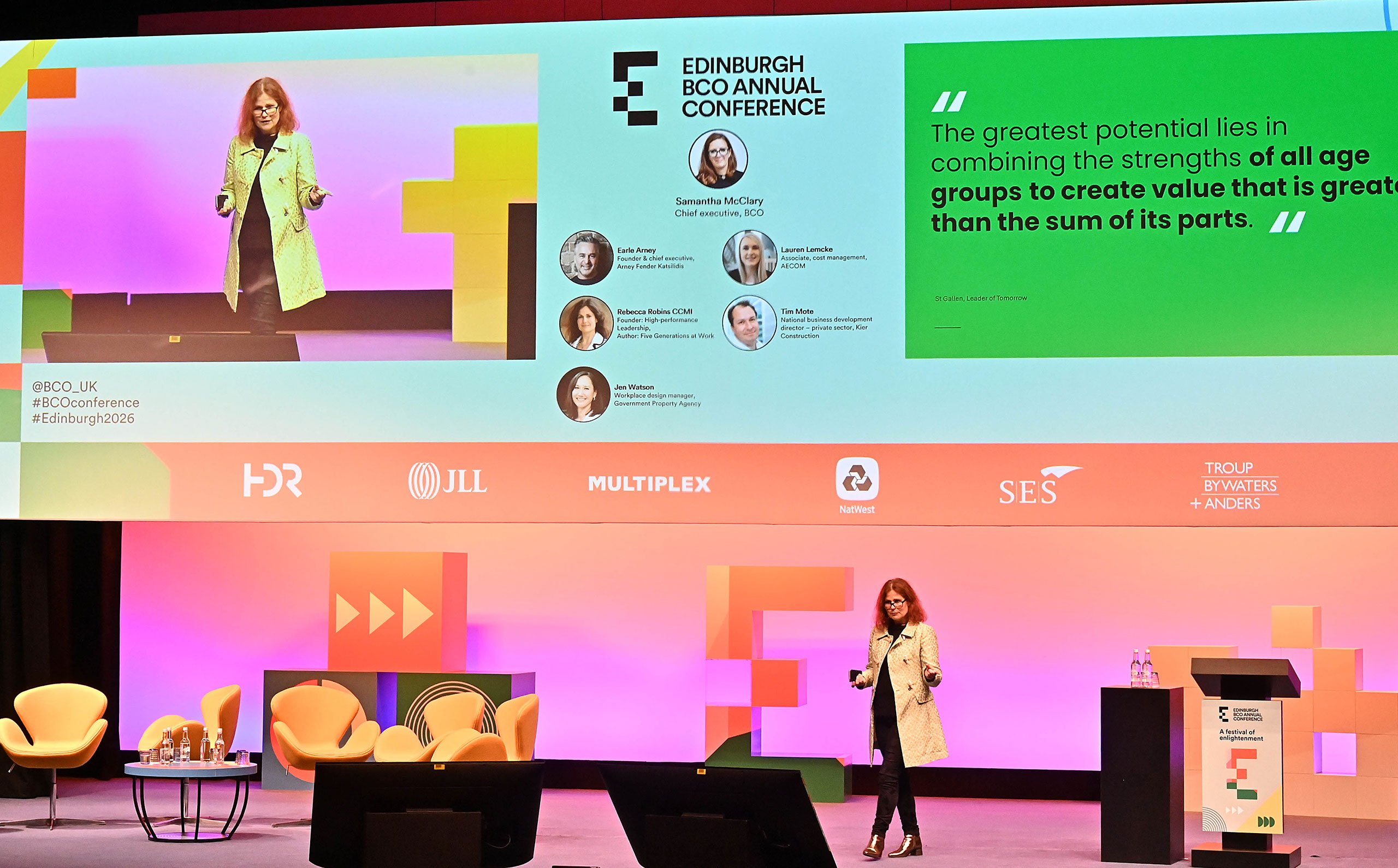
BCO Conference 2026 insights: When the first significant wave of Gen Z employees entered full-time employment in the early 2020s, their arrival signalled the emergence of the five-generation workforce.
The youngest cohort – born between the late 1990s and the early 2010s – joined the ranks of the working population at a time when some Silent Generation employees – those born up until the mid-1940s – were extending their careers beyond traditional retirement age. As a result, five generations are now working alongside each other, creating one of the most significant demographic shifts in modern employment.
This raises an important question for our industry: Are today’s offices equipped to support a labour force spanning seven decades?
Not really, said Rebecca Robins, author of Five Generations at Work.
“We are missing out here,” she warned. “While 81% of employers agree that a multigenerational workforce is key to growth and success, less than 10% have the policies and programmes in place to support it.”
And it’s not just office employees spanning so many generations. It’s the entire world of work.
“We have five generations of customers and stakeholders too,” said Robins.
“The future of successful companies rests on understanding this shift. Embracing it, or not, could dictate whether you are still in business 10 or 15 years from now. So how do we unlock all of that potential?”
Intergenerational conflict
In short, we need to move beyond intergenerational conflict at work, which requires a fundamental culture shift towards intentional inclusivity and a complete eradication of age-related stereotypes. To do that we need employees of all ages to understand why there are different approaches to work across the generational divides.
It’s all about context, said Robins. And appreciating this, above all else, is the key to reducing conflict.
“We all need to understand why different motivations at work exist,” she said. “If you are starting your career now, for example, and you know we have an ageing population and that most of us will live longer than previous generations, you may not want to work for a law firm the way people did previously. You might decide that spending 90% of your week at the office is not for you, and for good reason.”
Decisions like this should be accepted as indicators of evolving social norms, not weaponised to fuel stereotypes, Robins added.
In many ways, office design has kept up with the changing nature of age-based employment much more effectively than attitudes. Kier’s director of business development, Tim Mote, pointed out how the cellular offices and the closed-door policies that traditionally kept senior – and often older – directors separate from everyone else have seen a sharp decline.
But there is still a long way to go when it comes to creating physical spaces that better support a multigenerational workforce. And not everyone is aligned on how best that can be achieved.
Jen Watson, design manager for the London estate and Whitehall campus at the Government Property Agency, strongly advocates the power of collaborative space to bring workforces together for cross-generational discussion, conversation and harmony.
“Designing for all generations means creating and protecting those [collaborative] spaces,” she said.
Earle Arney, founder and chief executive of AFK Studios, was less convinced, however, and argued that promoting and protecting collaborative spaces at the cost of different sorts of work environments was a mistake.
“Work requires us to complete a multitude of tasks, some of which are quiet and focused,” he said. “Designing an office for one task for the entire day is absolutely crazy. This is as much a diversity issue as it is a generational issue. The way people think and communicate is vastly different, not just because of their age but because of who they are as people.”
Creating harmony
He added that another potential driver of harmony across the five-generation workforce could come, somewhat ironically, from what he referred to as the sixth generation: AI.
“If we consider AI as part of this discussion, then there are actually six generations in the workforce. Technology and the way we are using AI is really democratising access to knowledge, which will radically transform the traditional structures of the workplace.”
This could be a game changer in terms of levelling the playing field and minimising conflict across workforces, said Arney.
Just don’t use it to ask for an overview of each generation, said Lauren Lemcke, an associate at AECOM and the most recent winner of the BCO NextGen Ideas competition.
From Gen X – “independent cynics who just want to be left alone” – to Millennials – “entitled job-hoppers who expect rapid promotion and constant praise” and Gen Z – “always on their phones, don’t really want to work but expect to be the CEO by 30”, the portrayals were far from flattering.
It was an amusing exercise that revealed a real problem, said Lemcke.
“I didn’t ask for a negative description. But AI has automatically given me one,” she said, adding that this said a lot about how we tend to speak about and perceive generations.
After asking the same question but clarifying the answers should be positive, things looked and sounded very different. Gen X became “independent, pragmatic, adaptable problem-solvers”. Millennials were described as “collaborative and purpose-driven” and Gen Z was upgraded to “digitally fluent, entrepreneurial and challenging the status quo”.
Ultimately, it’s all about perspective and appreciating that a successful multigenerational workplace is not one where everyone works in the same way, but where different experiences and approaches are recognised as strengths.
Not just five generations at work, but five generations that work.
Words by Emily Wright



 By BCO Media