By Katrina Kostic Samen.
As an active voice of the BCO Board for the last 12 and a half years, eight as a board member and more than four within the presidential team, it is now time to pass the mantle on to new leaders and the next generation. I have met so many fascinating people who have helped us reach genuinely impressive milestones and create lasting change for the industry.
One of the main reasons I campaigned to join the BCO Board all those years ago was to give something back to the industry. I felt it was also time to steer the organisation in a different direction, which up until that point had not successfully integrated occupier opinion. My goal, therefore, was to ultimately align the end user’s business needs with the built environment, enhancing wellbeing and enabling choice from an inside-out perspective.
I was approached to join the presidential team in January 2016 because I represented a younger, more vibrant occupier focused female lead who had a reputation for challenging the status quo, and I’m pleased to say that’s exactly what I did!
I was well aware of the lack of senior female role models in the industry, particularly on the BCO Board. As only the third female president in the organisation’s 30 year history, this transformation was not something I took lightly. Equality is still lacking across many industries and real estate is no exception.
Despite this, we have made significant inroads when it comes to diversity & inclusion. In fact, the 2018 conference in Berlin saw female attendees increase by as much as 17%, a vast improvement on previous years. In order to continue this progress, as part of my presidency I aimed to ensure that there were at least two women of merit on each BCO committee.
Another key priority was supporting our NextGen colleagues. We invited younger members to attend Berlin, supporting their platform within the BCO. We now also offer free student membership and even a seat on the Main Board. As with all industries, our future lies with those that come after us and it has been a passion of mine to ensure that we continue to encourage our future leaders. Creating a mentorship programme where senior people in our industry coach the stars of tomorrow through various means, is already well underway throughout the UK.

The BCO is undoubtedly a magnificent organisation, but it has sometimes retained a façade of formality and, in some cases, rigidity. As an industry in a constant state of change we must be prepared to respond accordingly and consciously adapt. I did not just want the organisation to be the British Council for Offices, but to also stand for Building Communities for Occupiers, continuously evolving its remit when it comes to engagement and diversity.
I am extremely proud of the fact that together we have managed to achieve so much. By creating a positive legacy and effecting real change within the BCO, I look forward to the future, certain that we will not go backwards. Last year saw workspace firmly in the spotlight and despite the many challenges, it has provided us with a unique opportunity to rethink and reshape our office buildings, public realm and neighbourhoods.
We need the industry to grow alongside what occupiers want and what the future generation needs; the pandemic, for all its faults, has provided a catalyst to ensure this continues to happen and I know that the current BCO leadership team will undoubtedly carry on what we started.
Here’s to being bold and brave as we head into 2021.

2020 Brought forward a series of new challenges for all; from a global pandemic, tackling the impending Climate Crisis, and addressing ongoing issues around Equality and Inclusivity.
That is why the BCO NextGen were thrilled to bring back the BCO NextGen Competition for a second time in 2020. First launched in 2017, the BCO NextGen membership were tasked with looking beyond the Pandemic and sharing their vision of the Office in 2025.
As the office sector faces seas of change, we challenged entrants to imagine a better future. Entrants were encouraged to think outside of the box to present innovative and thought-provoking solutions that bring to life how the workspace may change over the next five years.
Entrants were free to choose their own theme related to the current global state, or one of the below:
Shortlisted entrants presented their ideas at the ‘Pecha Kucha’ style webinar on 9 December, with the competition’s judging panel announcing the joint winners at the end.
Competition judge and BCO’s Immediate Past President Katrina Kostic Samen praised all five teams for the amount of work that went into delivering the presentations and thought leadership while working in teams, completely isolated during the pandemic.
By Gina Colley, Threesixty Architecture Ltd

“COVID exacerbated many social issues such as gender inequality, men’s mental health, and isolation of the disabled community. Hopefully, we are now at a place where there is light at the end of the tunnel – an important time to pause and consider how we rebuild some of the structures that have fueled these inequalities. Scattered Space is a model that can help businesses build an agile network of premises. The aspiration behind it is to bring more opportunity, more equality, and more life to the workforce.”
By:
– Chris Radley
– Sam Ki
– Benjamin Koslowski
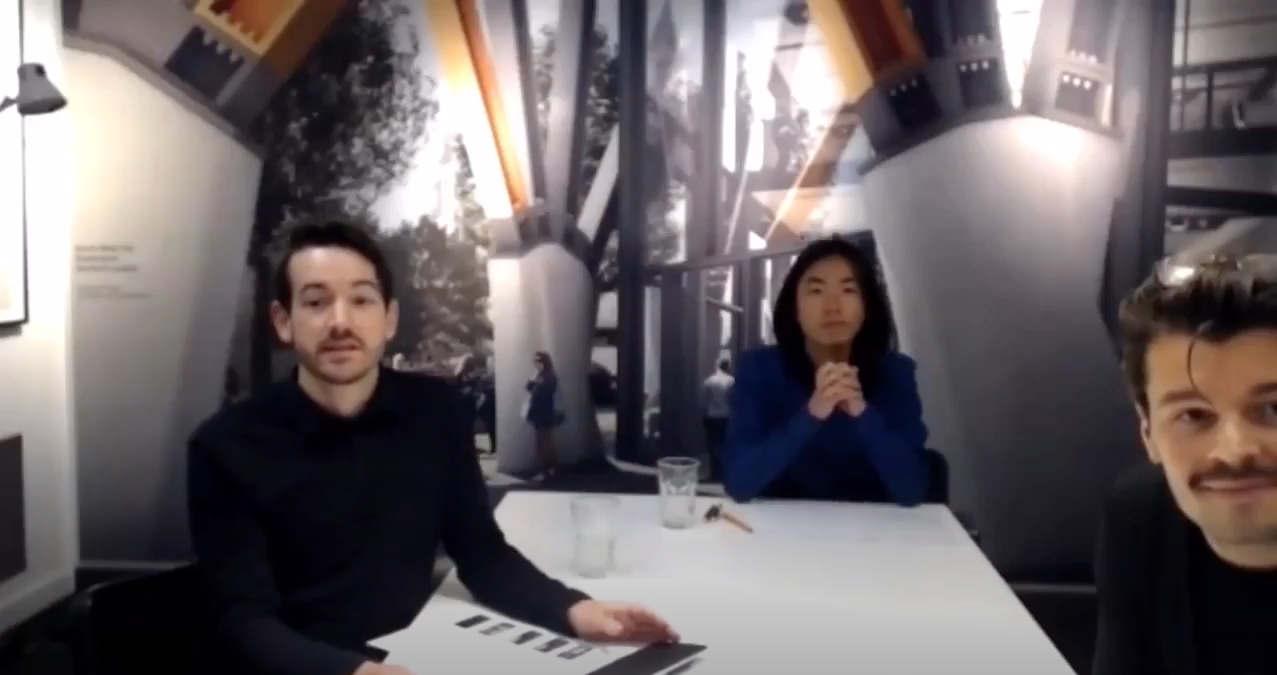
“Grown from our research and conversations we’ve had with colleagues, three key themes were health, sustainability, and experience. Futurework is a short animation that looks at where we work and rethinks the workspace as a network of connected places.”
Watch the full recording of the Top 5 teams at the event where the judges had the difficult talk of choosing the winners here.
By Annabel Koeck, Associate at Grimshaw Architects
#BCOvoices is a new series of blogs by the BCO. We’ll look at the impact of Covid-19 on the commercial property industry, along with broader topics. If you would be interested in contributing, please contact chane.scallan@bco.org.uk.
In 2017, I made the decision to take part in the BCO’s inaugural NextGen design competition. Our challenge was to imagine, and then design, ‘the office of 2035’ and answer questions about both what it would look like, and how it would support the way we work. Little did I know then, that those questions were only going to get bigger.
I’m proud to say that our team, Team 88mph, won that first competition. It was an opportunity that allowed me not only to meet my peers and introduce my work to the industry, but to learn from new perspectives, test the boundaries of what I can do – and, incredibly, do it all in a safe environment. It is an opportunity I remain incredibly grateful for.
This year, the BCO is bringing back it’s NextGen competition and asking our industry’s brightest young minds to re-imagine what the post pandemic workplace looks like, in just five years’ time. The stakes are higher, the time frame more immediate – but the challenge is just as irresistible as the one I signed up to.
With the final deadline for entries approaching, it felt appropriate to reflect on some of the lessons I learned from my experience two years ago.
“Parameters are the things you bounce off to create art”*
The BCO is asking NextGen members to consider the most pressing issues affecting the here and now – from the global pandemic and tackling the impending climate crisis, to addressing ongoing issues around equality and inclusivity.
The competition provides a unique opportunity to set your own parameters and decide what challenges you want to focus on. A response to this competition is a chance to create your own future – whether that be a response that is specific to a location, to a challenge, to an occupier, to an age group, or sector.
This year we’ve also faced one of the biggest challenges our industry has ever seen: the coronavirus pandemic. But, this challenge also opens up opportunities for more creative solutions. Don’t be afraid to push the boundaries and try something new.
The benefit of new perspectives
Stuck at home all day, many of us have lost the opportunity to learn from colleagues and external mentors, meaning our networks may feel more limited than ever.
Taking part in the NextGen Design Competition provides an excellent opportunity to do something about it and connect with new faces – whether colleagues you’ve never worked with before, peers from other firms or external consultants. I can honestly say that I was pleasantly surprised that the consultants I asked, and didn’t know very well at the time, were so interested in working on an unpaid, hypothetical competition! So make the effort, understand their perspectives, broaden your network in the built environment sector, and work in the interstitial space between all your specialties to really innovate.
What are you waiting for? Make sure you sign up and get involved here before entries close on 29th November.
*Quote from Neil Gaiman, English author
Article originally posted on LinkedIn by Annabel Koeck as part of the #bcovoices series.
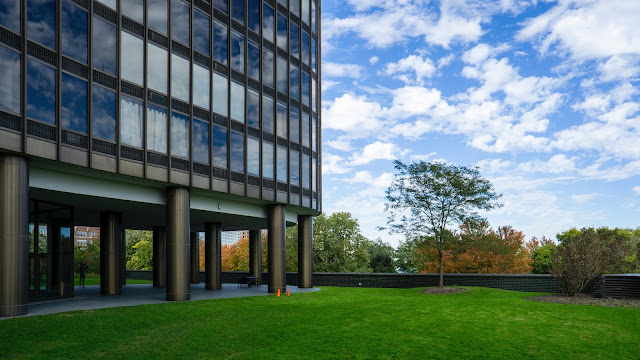
Photo: Jimmy Tompkins
Like so many others, the office sector has spent the past five months focusing on the physical threat posed by COVID-19. Social distancing, one-way queuing systems and an endless barrage of reusable masks have quickly become crucial elements in our line of defense to make sure we protect people’s physical health and get Britain back on its feet, safely.
But as time ticks on, it’s important we don’t let mental health drop from the agenda.
With most of the UK working from their kitchen tables, colleague contact reduced to weekly Zoom or Teams calls and natural development opportunities largely stagnated in a newly virtual world, protecting mental health in the workplace is more important than ever.
As the UK begins to think more seriously about a return to the office, the sector is faced with a new opportunity to reinvent the way we build for, and manage, mental health in the workplace. In 2018, the BCO published a seminal piece of research called ‘Wellness Matters’ – that began to shape what practice wellness really looks like – but two years on, the world is a very different place, and it’s even more important that we take this opportunity to really embed these principles into the heart of our office designs.
As remote working continues to soar in popularity, employers face pressure to go beyond the typical wellbeing gimmicks – gym discounts and the odd free banana – and look to add a real sparkle or wow factor that helps to reassure workers that their wellbeing is being taken care of. The Flourish Model was a principal part of the framework introduced in the Wellness Matters Report. The ‘wow’ factor is an important ingredient of The Flourish Model, focusing on aspects that aren’t traditionally evaluated but still remain important – such as natural light, views out on nature, colour and green landscaping in the office.
It’s these enticing elements, combined with greater social interaction, that make a return to the office a relishing prospect.
See The Light
It’s no secret that natural light and fresh air have an enormous impact on worker wellbeing.
Natural ventilation is preferable in the office or home, hence the importance of many windows to let daylight and fresh air enter the building. For buildings in cities this is a challenge and also requires a good match between the building form and internal layout to allow a flow of air to be effective for the occupants.
And while home working is attractive for some it carries limitations for others. A lack of space, natural light, poor ventilation, noisy distractions or social isolation mean it is more likely than we need a more flexible and blended approach to arranging our working lives.
Reconnect with nature
Having spent months limited to one daily outdoor allowance, many of us have become quite accustomed to being at one with nature and enjoying the views of our local green spaces for some mental relief. A moment in nature can inspire creativity, particularly when physical human interaction isn’t available.
The Flourish Model begins to unpack both why and how office buildings should aim to provide a similar multi-sensory experience The senses need stimulation to keep the brain performing at its best. Atmospheres that lack good air quality, natural lighting or personal temperature control, for example, can sap workers’ energy and dry up any chance of creative thinking.
Green landscaping is easily implemented in offices no matter their shape and size and goes far beyond scattering potted plants across desks.
The emergence of biophilic design through vertical gardens, green walls, or architecture built specifically to make a statement can be given more soul by indoor landscaping and this can make people feel less stressed and more creative.
Active working
Remote working provides more opportunities to be active throughout the workday. Whether it’s enjoying daily exercise during a lunch break or regular stretching in between online meetings – such movement allows workers to break up their daily schedule and prevent musculoskeletal problems building up in the body.
Moving around is essential for health and wellbeing and should be incorporated into work life – wherever we are. When in the office, workers should be encouraged to take meetings in local parks, weather permitting, for example. Likewise, privacy booths are becoming more common and allow us to get our daily dose of quiet mindfulness, which the brain needs to replenish the mind.
All in all, it’s clear COVID-19 will change the way we plan and design workplaces. If we are to create environments that are healthy, have low infection risk and help people flourish, we need to consider all the elements in the Flourish Model, as shown in the BCO Wellness Matters Report, so that we can inject life and resilience back into our office workforce.
Derek Clements-Croome, Professor Emeritus at Reading University
Derek’s new book Buildings for People: Sustainable Liveable Architecture, will be available to purchase in late October.
#BCOvoices is a series of blogs by the BCO. We’ll look at the impact of Covid-19 on the commercial property industry, along with broader topics. If you would be interested in contributing, please contact chane.scallan@bco.org.uk.
Dan Bayley, Head of Tenant Representation, BNP Paribas Real Estate

Ten years ago, the relationship between landlord and tenant was simple. It centered around rent collection day. In today’s world though, this transactional relationship isn’t enough.
Recently, landlords have had to familiarise themselves with the wants and needs of a new, altogether more challenging occupier. This occupier demands more than just four walls and big windows. This occupier demands that customer experience be put first and look for workspaces that are as nice to work in as they are to look at.
For the landlord-tenant relationship, this is changing the way the two work together. Landlords are expected to be more open and collaborative in their approach. To keep an occupier happy, and protect the opportunity for long-term security, landlords need to be flexible. This makes the job more challenging. It also makes it a lot more interesting as landlords juggle evolving customer expectations with the realities of what they can control.
The first concern for most occupiers is culture. Whilst seasoned managers may mock the ‘fussy’ millennial worker that expects integrated tech, hot desks and beanbags, the reality is that these softer elements of office design and fit out, when applied correctly, can have a very material impact on a business’ ability to attract and retain the best talent.
This isn’t to say that an office without beanbags and slides won’t attract great talent. The fantastical offices of tech land aren’t appropriate for all sectors and businesses, nor should they be. However, other sectors can and should apply creativity to their office designs. Whether it be a large central socialising area, a selection of breakout areas that offer different work set ups, sound-proof privacy booths or quiet zones – it is important to offer occupants the choice of where they want to work. Different spaces for different moments and different work demands.
At a time when the role of the office is being questioned, this flexibility is more important than ever. The reality of COVID-19 is that the office market is facing greater competition. For the first time, it’s competing with the home and so offering a variety of spaces that can cater to many needs, rather than the single workspace available to most of us at home, is vital.
The second element of office design on most occupiers’ minds today is tech. The everyday worker doesn’t care about how high the ceiling is or who has the flashiest furniture. People want a seamless experience with technology that is intuitive and responds to their changing needs.
Yes, technology is evolving with a never-tiring speed. Sadly, though, that’s no excuse for being left behind. It’s up to landlords to accept this challenge and deliver change that keeps up with the world outside our front doors, or we risk being lost to it. When invested in properly, both financially and through the correct facility management roles, technological solutions can improve the efficiencies we manage as landlords as well as the experience of our occupiers. It can help landlords better measure occupancy levels and air quality that ultimately helps them save on energy, while making the office feel more comfortable for those within it.
Another important aspect is standards such as WELL, Fitwel and Wired and they are becoming increasingly important to both landlords and occupiers. These standards are reassuring for occupiers looking for space as they certifies certain aspects the building sets out to deliver. Equally, it allows landlords to offer a much stronger positioning of the building to future occupiers.
I think the future relationship between occupiers and landlords will be much more collaborative, built on two way communication with the aim to find the best solution for a particular tenant. Being transparent with your occupiers will benefit both parties, allowing them to be honest about their needs and allowing you to be transparent about the challenges so that you’re able to deliver a pragmatic reality that meets the needs of both parties.
As COVID-19 brings new questions to the fore about the role of the office, I would encourage all landlords to embrace the change. By starting an honest conversation about your occupiers’ needs and demonstrating that you can, and you will, continue to learn and adapt, everyone wins. By working together, landlords can deliver better offices, filled with happier and more productive people.
Originally posted on by Dan Bayley as part of the #BCOvoices blog series on LinkedIn.
#BCOvoices is a new series of blogs by the BCO. We’ll look at the impact of Covid-19 on the commercial property industry, along with broader topics. If you would be interested in contributing, please contact chane.scallan@bco.org.uk.
18 May 2020 | by Adam Bray, John Redfern

As the unexpected turn of events of 2020 has us all re-assessing daily life as we know it, attention now turns to the future of workspaces and how they will operate.
The role of a proactive and forward-thinking managing agent and landlord is to anticipate trends and the demands from its customers. However, nobody could have predicted the huge impact that COVID-19 has had. Nonetheless work patterns have shifted significantly in recent times, as customers have come to expect more from the spaces they occupy, opting for greater flexibility and enhanced services.
Clearly there are new challenges on the horizon as the industry grapples with social distancing, and technology will play a part in providing solutions. Many landlords of landmark buildings are pushing the boundaries of customer service, and it’s vital that property management strategies focus on helping to achieve this vision, whilst also challenge boundaries of our own and provoking debate to stimulate innovation. This will be especially important as we begin to return to the office after lockdown, and as we look to implement new ways of working and interacting.
The BCO has previously reported that efficiency, flexibility, adaptability, sustainability and wellbeing continue to be of top concern to occupiers. Office building owners and managers are increasingly being asked, and now expected, to offer a service that supports these business objectives and this isn’t going to change any time soon. In the current environment, adaptability, health and wellbeing will be at the top of everyone’s agenda and the role of the property manager will be to deliver the services to support this.
To do this effectively, engaging clearly and consistently with occupiers is paramount in understanding their specific needs. At a basic level, property managers are already hosting regular occupier meetings and video conferencing calls, but the adoption of technology has enabled a greater and more granular access to information about buildings through mobile apps and smart building measures. It has also facilitated the creation of platforms that enable real-time building feedback, digital twin modelling and platforms to integrate smart building functionalities including speed-gate integrations and air-quality sensors. Technologies like these post-COVID will be of utmost importance to ensure seamless and contactless building access, reducing touchpoints and assisting with frictionless movement around the building, as well as providing a one-stop-shop centralised communication tool.
There is already a revolution underway, moving from customers’ requirements for ‘space as a commodity’ to ‘space as a service’. This has been spoken about at length in the past and the BCO has been producing research and recommendations on occupier satisfaction since 2002. Their 10-point action plan and set of checklists that measure the performance of a building forms the basis of our RISE strategy, which we have in more than 60 sites, home to over 60,000 occupiers.
In order to successfully assess and address the performance of a building it is incredibly important to receive this feedback to enhance services. It is also important to offer transparency in management services, and to quantify how well service is delivered. In our buildings, through RISE, we have introduced a certification scheme which is designed to do exactly that. This independent audit, which assesses the standard of compliance with the requirements and expectations of occupiers and landlords, allows service levels and performance across prime offices to be raised through benchmarking and the creation of a bespoke framework to deliver services that address gaps in services.
The significance and effectiveness of this bespoke framework and benchmarking can be shown through our work at Cannon Place where the initial independent assessment score of 41% was improved to 92% in just one year. The speed of this improvement was the result of following a series of processes by working closely with the occupiers and landlord to align expectations with their goals and requirements. This cumulated in the production of a bespoke action plan, the creation of a customer experience strategy for the building, along with implementing the RISE action plan with a 5-step programme focusing on: operational excellence, customer experience, sustainability and wellbeing, innovation and CSR.
As we now move into a phase of lifting the lockdown with a potential phased return to work, we expect more focus on the role the building plays in wellness, scrutiny of cleanliness and how facilities are managed, as well as opportunities to improve interactions through technology. Tools such as Customer Journey Mapping will be paramount as we have a period of the ‘new normal’ and those journeys change.
Ultimately it is collaboration, transparency and a structure to implement multiple plans and processes, that helps to ensure that building occupiers and building users’ needs and expectations are met. To be able to quantify that to the owner and their customer is a powerful tool to drive constant evolution and improvement of service. As we are all acutely aware, the challenge now lies in adapting this customer-centric model to one which operates in an environment that sees restrictions imposed on gatherings of people, and individual mobility stymied by Government regulations as a result of the pandemic. Coronavirus may have driven people indoors, but there has never been a stronger need for community and interaction.
Originally posted on React News.
#BCOvoices is a new series of LinkedIn blogs by the BCO. We’ll look at the impact of COVID-19 on the commercial property industry, along with broader topics.
It’s been close to a month now since most of us packed up our desks and set up shop at home. Some of us, I’m sure, have found that transition more challenging than others as we adapt our skills and our ways of working to meet the needs of a new reality.
That’s why The NatWest Group’s partnered with the BCO to provide tips on how to best work from home during this challenging period.
There has never been a one size fits all model for how and where we chose to work, nor should there be, but in sharing my five top tips below I hope to help those of you reading this find a little more clarity as we continue to work remotely.
1. Understanding feelings of guilt: it’s important to remember we don’t work relentlessly in the office; we take breaks and we don’t feel guilty when we do so. Yet this changes when we are home. We feel the need to ‘prove’ that we are always working, always ‘on’.
Instead, I challenge you to recognise that that it’s OK to put a wash on, put it out, spot that it’s raining and run quickly into the garden to bring it back in. Life goes on – yes, even when we’re at work – and taking natural breaks can be necessary. It can also improve our concentration when we are back at our desks, ultimately resulting in a more productive working environment.
2. Communicating mindfully: working at home can be a lonely existence, as we lose the “informal chat” of the workplace. Try to talk to colleagues and allow time in meetings for conversation.
What’s more, isolation can “mean you read too much into any hastily written emails”. It’s best to assume “good intent”, rather than fret over a brusque reply.
3. Defining a workplace: when working from home, it’s easy for the boundaries between work and life to blur. Make a conscious effort to keep them separate by defining a set space in your house as your workplace. Keep that place tidy and think about its lighting and space, all of these factors will help you stay focused.
4. Making virtual meetings matter: meeting virtually can be tough, so it’s important that actions are clear, and work is completed.
Before a meeting, agree an agenda and clearly outline what you expect to come out of it – just like you would in the office.
It’s easy for the endless conference calls to feel tiring and passive, too, so if you lead a team make a conscious effort to include all parties when you meet. Can you give everyone a new responsibility? Can you set everyone a challenge? If late in the day, is it worth kicking off the meeting with an ice breaker?
5. Building trust through feedback: providing honest, fair feedback has become more important than ever. Without regular contact, junior members of the team may feel they lack guidance.
Without feedback, our work suffers, and keeping issues bottled up or trying to conceal them – whether they’re perceived or real – can harm trust with all too tangible consequences.

These are unprecedented times. In what feels like the blink of an eye, the coronavirus pandemic has changed the way we work.
We know that working from home can be challenging, which is why we have partnered with NatWest to share with you some tips on how to be more effective when working from home.
The tips include thoughts on how we can enhance our home work stations, how we can effectively communicate with colleagues remotely and how we can build trust and resilience in our teams.
“We are really pleased to be able to share our resources to help members of the BCO and all their colleagues and customers.” -Andy McBain, Head of Choice & Office Design, Property Services, NatWest Group, Member of the BCO Scottish Committee.
Download the full document published in April.
For more tips on working from home, keep an eye on the new #BCOvoices blog series on LinkedIn. The series brings together different members, all sharing their thoughts on how we can work effectively at this time and in the future.

We recently worked with Business and Industry on the 2019 Employee Wellbeing campaign. A printed publication was enclosed within every copy of the Guardian newspaper and the content is available online at https://bit.ly/2qnjuG2. The campaign featuredexclusive content from BCO President, Paul Patenall and key thought leaders and industry voices about mental health in the workplace, the stigma attached to this and how employers can create the best working atmosphere for their employees.

London – A joint-research from Gensler and the British Council of Offices (BCO) on the rise of flexible workspace in the UK corporate sector has uncovered that 40% of flexible space users would rather work from a conventional office, prompting questions about the viability of the flexible space solutions as it currently stands.
Key findings include:
· 40% of flexible space users would rather work in a traditional office set-up;
· Satisfaction rates for spatial and service features were 12% lower for London compared to other UK regional cities;
· Only 29% of the respondents agreed or strongly agreed that the flexible workplace had increased their efficiency for tasks where they needed to concentrate, while 38% disagreed;
· 69% agreed or strongly agreed that their workplace helped them to collaborate more;
· 57% of flexible workspace users reported being happier at work.
While the future of co-working is increasingly being explored as part of academic and industry research, there has been limited focus on what it means for large corporate occupiers. The 2019 Rise of Flexible Workspace in the Corporate Sector Report aims to do just that by identifying the drivers of – and the barriers to – the use of flexible space and co-working by large corporate occupiers.
Co-working has evolved from being the realm of freelancers and start-ups to being part of the corporate arena. As uncovered in Gensler Research Institute’s US Workplace Survey 2019, 14% of respondents working for companies of 100 or more employees reported using co‑working space for part of their average working week. The latest and increasingly dominant revolution in co-working shared space has seen employees of large corporates working away from their main office space outnumbering freelancers. In 2018, corporate occupiers made up a quarter of WeWork’s members and revenue globally. However, the recent developments of WeWork will have a knock-on effect on how the co-working model moves forward. Especially so with the likes of Knotel, whose business model is geared entirely towards large corporates.
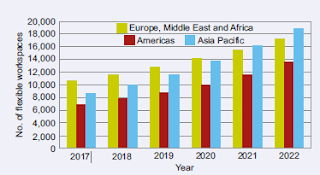
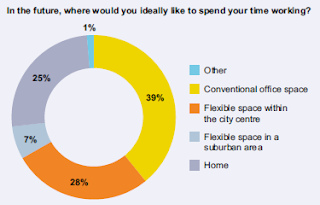
Despite this rising trend, approximately 40% of flexible space users would prefer to work from a conventional office. Comparison of the preference for traditional versus flexible space across industry sectors shows that 46% of those in consulting services would prefer to return to a traditional set-up, compared to 37% in financial services. Cesar Jeri, Digital Workplace Strategy Lead at Verizon comments, “a one-size-fits-all flexible workspace does not cut it. There are still many firms with a high degree of process with individual focus needs; so flexible and collaborative spaces can be highly distracting for some whilst energising for people in other parts of the business. A workspace needs to be first and foremost inclusive and empower people to make a choice so that it can address the needs of most, if not all, its end users.”
Corporate users: Future of co-working
UK-based large corporates are at different stages in the adoption of flexible workspace. The more mature corporates adopting flexible spaces have combined several approaches that enable them to collect feedback on user experience in order to have a better understanding of the type of spatial settings and flexible working arrangements that drive employee productivity and enrich user experience.
Having initially favoured individual memberships of co‑working spaces or taking space on-demand for a specific project, large corporates in the UK are now increasingly seeing the benefits of either developing their own co-working area within their real estate portfolio or leasing a private area in a shared serviced space. Collaborative or shared spaces were rated as the top three spatial features in the user survey conducted for this study.
The individual membership model is generally implemented as a ‘quick fix’ approach, with a number of large corporates adopting this model as a supplement to, or even as a replacement for, ‘swing spaces’ – with the aim of accommodating peaks and troughs of demand, which they have traditionally held within their own real estate portfolios.
As Jane Clay, Principal and Design Director at Gensler highlights, “Our research suggests that the companies interviewed are all progressively moving away from this individual membership model and capitalising on lessons learned – implementing a flexible workplace strategy in their own space where they can influence its design, tailor the user experience and envision specific business outcomes. This approach also has the added benefit of enabling large corporates to personalise their space and showcase their brand within a less traditional work environment, with a direct positive impact on their recruiting process.”
Research was based on responses from 540 corporate users of flexible space from financial services (38%), real estate (36%) and consulting services (21%), amongst others. Companies interviewed include British Land, GSK, RBS, WeWork, Microsoft, Vodafone, HSBC and Verizon.

The full report, The Rise of Flexible Workspace in the Corporate Sector can be downloaded here
News release by Gensler. For more information, please contact:
Amelie Barrau, Regional PR Manager, Gensler: amelie_barrau@gensler.com / 079 6797 5844
3 Monkeys Zeno, PR Agency: Gensleruk@3monkeyszeno.com / 020 7009 3100
About Gensler
Gensler is a global architecture, design and planning firm with 48 locations and more than 6,000 professionals networked across Asia, Europe, Australia, the Middle East and the Americas. Founded in 1965, the firm serves more than 3,500 active clients in virtually every industry. Gensler designers strive to make the places people live, work and play more inspiring, more resilient and more impactful. www.gensler.com
Sponsored by:

The results are in for the 2019 Annual BCO Conference photography competition! In 2018, “BCO Photo Berlin” was introduced for the first time, devised by Art Acumenfor all BCO delegates who were invited to take photographs of Berlin over the course of the event capturing ‘Diversity’, ‘Inclusion’, ‘Connection’, and ‘Innovation’. This year, the Waterman sponsored competition saw 350 entries submitted via the all-new conference appor e-mailed in. The judging criteria: Originality, basic technique, visual impact and adherence to either one or both of the following subject matters:
CONGRATULATIONS to the following winners:
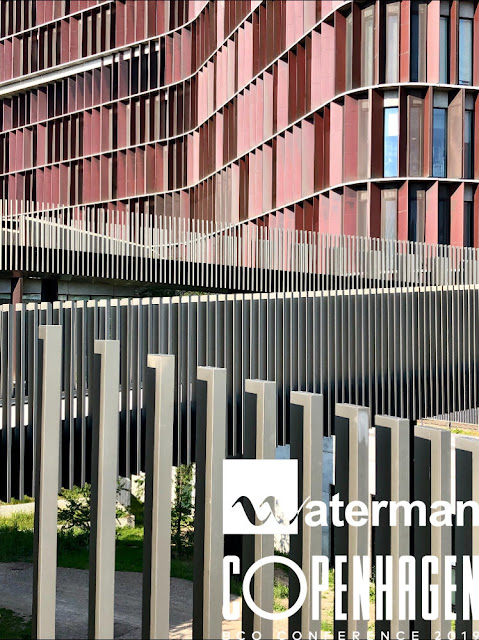
1st PLACE for ‘Copenhagen Architecture’
Maersk Tower by Giles Martin, WilkinsonEyre, submitted via the conference app.
Judges’ comments:
-“Nice composition, it draws you in.”
-“Visually delicious.”
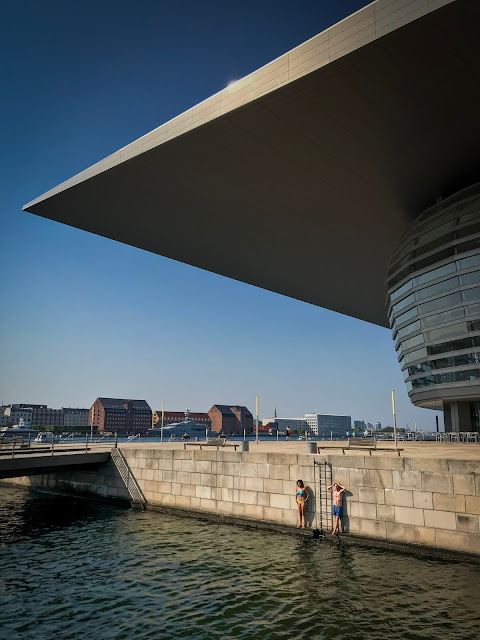
1st PLACE for ‘Arbejdsglaede’
Royal Danish Opera House by Ben Marston, Jestico + Whiles + Associates Ltd, submitted via e-mail.
Judges’ comments:
-“Beautifully composed with great use of scale.”
-“Captures the perfect light.”
-“The more you look at this image the better it gets.”
CONGRATULATIONS to the 5 highly commended:
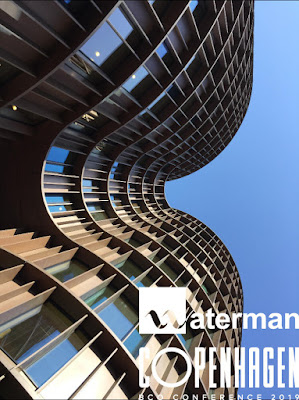
Highly Commended – Copenhagen Architecture – Chris Levett, DLA Design
-“A strong composition, with a great study of light and shadows.”
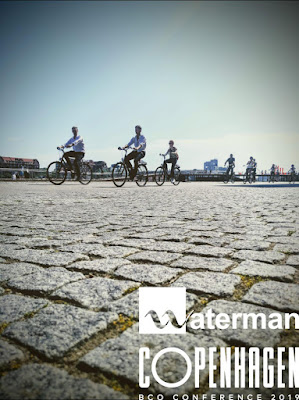
Highly Commended – Arbejdsglæde – Alex Parsons, Kajima
-“Captures the theme really well.
-“Interesting division of the composition….it puts the people right in the centre.”
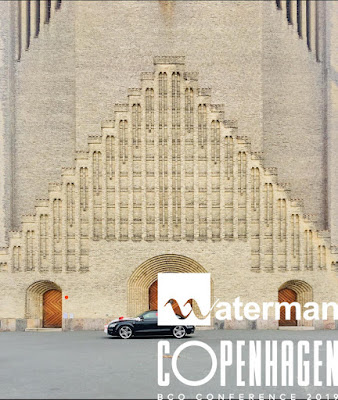
Highly Commended – Copenhagen Architecture
Borja Marcaida, Sheppard Robson -“A simple and formal composition, with a wonderful human element.”
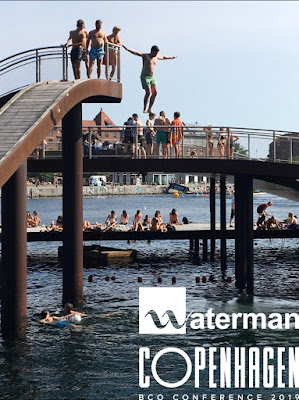
Highly Commended – Arbejdsglæde – No Name
-“The photographer has captured the wonderful energy of Copenhagen life.”
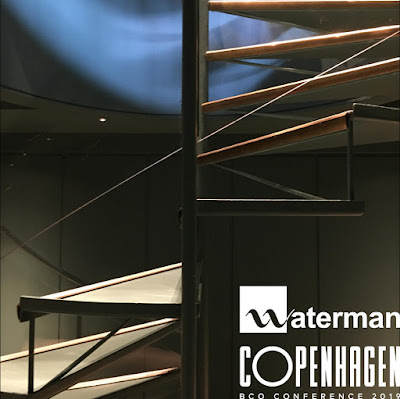
Highly Commended – Copenhagen Architecture – Mark Simpson, BDP
-“A stark graphic image, full of intrigue.”
-“The light and shadows are just beautiful.”
THANK YOU TO OUR JUDGES:

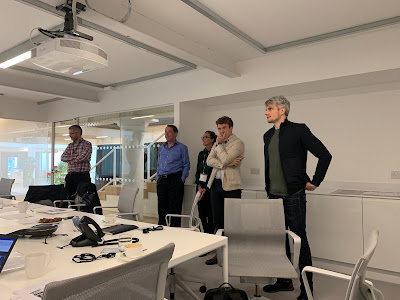
Photo competition judges joined by BCO Snr. VP and Conference Chair
Paul Patenall
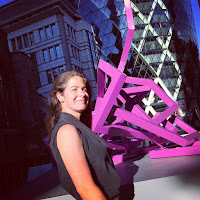
-Catherine Thomas, MD, Art Acumen (Judging Chair)
Catherine is the Managing Director of Art Acumen, specialising in curating and commissioning art collections, devising bespoke creative projects and place-making through public art programmes. For the past 16 years, Catherine has delivered visionary art strategies and inspirational art commissions for many corporate, public and private clients, building a formidable portfolio and excellent reputation. Catherine created and devised the 2018 “BCO Photo Berlin” Photography Competition as part of the Berlin Art Programme. Learn more here.
VIEW WINNERS FROM THE 2018 ‘BCO PHOTO BERLIN’ PHOTOGRAPHY COMPETITION DEVISED BY CATHERINE HERE.

-Miriam Spatafora, Structural Engineer, Waterman Group
Miriam grew up with a strong love of Literature and Arts, surprising everyone when she chose to pursue a career in engineering. With a strong eye for detail, she has notably worked as an engineer on the Royal Academy of Dance development. She has a huge appreciation and respect for the visual arts. Miriam loves photography and enjoys capturing a range of shots with her both analogic and digital camera, exploring the contrast between film and modern techniques.

-Martina Famoso, Engineer, Waterman Group
‘Martina is an engineer with a strong passion for Arts and Architecture. This passion comes from being born in Italy surrounded by its immense historical patrimony. When she is not working as an engineer, she loves to draw, paint and of course to walk around London taking pictures of the beautiful contrast between old and modern architecture.’

-Ryan Dempster, Architect, Buckley Gray Yeoman
An architect with an eye for aesthetics, Ryan is a BCO NextGen Rising Star for London and the South East. An avid photographer himself, with an impeccable eye for design, Ryan founded @storeyshots – a growing Instagram based community curated as a show and tell of architecture and inspiring advice from firms in the industry.

-Alex Upton, Architectural Photographer
Alex’s approach to architectural photography is informed and complemented by his background in studying both Fine Art (BA Fine Art First-class Honours, University of the Arts London) and Design. This not only assures his consistent attention to detail and quality but also enhances his understanding of form, space, composition and materials in relation to architecture.

-Simon Kennedy, Architectural Photographer
More than fifteen years of experimentation have informed Simon’s current photographic techniques. Simon’s photographic vision developed in a unique way – years of working as a qualified architect combined with teaching post-graduate architectural studies at The Bartlett School Of Architecture. This experience has given him a unique understanding of architecture, and a highly insightful photographic vision which continues to develop and be informed by his teaching practice at the Bartlett and by collaborations with various architects.

 August 28, 2026
  By BCO Media