BCO Conference 2026: A CEO’s reflections
Chief executive Samantha McClary shares her views on this year's incredible Festival of Enlightenment
 June 30, 2026


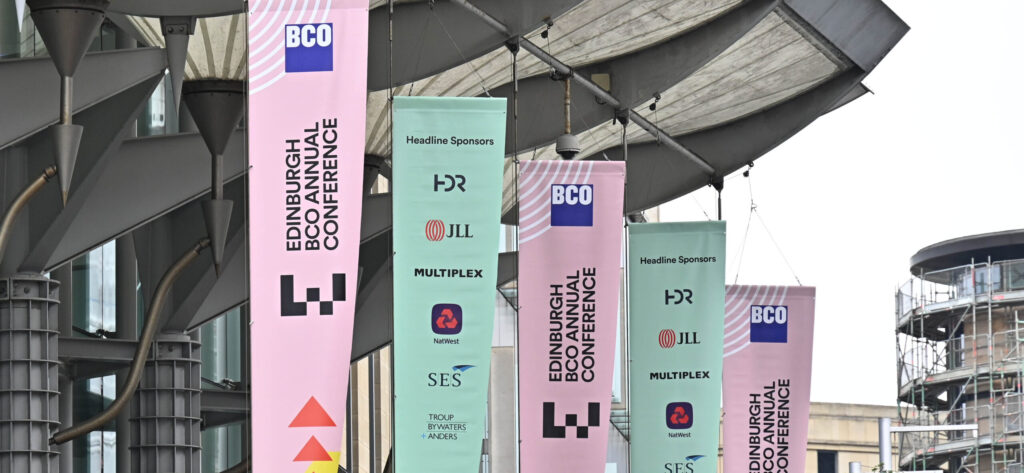
If there was one thing shone through strongly for me at our conference this year, it was that our sector – the office sector – has finally stopped talking about change as something on the horizon and started accepting that it is already here.
The Festival of Enlightenment felt to me like a line in the sand. Not because everything suddenly became certain but because the conversation has matured. There was less noise, fewer gimmicks, and a far more honest interrogation of where value really sits in the workplace.
While AI, of course, formed a big part of the conversations we had across the two days of plenaries, workshops and tours, the nuance was sharper. Much of that shift can be traced back to the brilliant Gillian Docherty from the University of Strathclyde. Her contribution in the opening plenary didn’t just land, it stuck. In fact, it arguably gave this year’s conference one of its defining refrains: don’t build “creepy” buildings.
On the surface, it’s a throwaway line. In reality, it cut straight to the heart of the industry’s current dilemma. Because this isn’t about rejecting smart technology, it’s about being honest about how it’s used. Buildings become “creepy” when they collect data people don’t understand, don’t consent to, or don’t see the benefit of. And that raises a much bigger question about trust and whether this sector has really earned it.
The AI pivot
This is where Docherty’s thinking noticeably shifted the tone of the AI conversation. Rather than asking what’s possible, she reframed it around what’s appropriate. And that feels like an important pivot to me.
What was equally powerful was her strong message that despite all the talk of automation, data and intelligence, AI won’t mean the death of the office. What it will mean is the death of the mediocre office.
This is an important message for us at the BCO to hear too. Our mission is to enable excellence in offices. Our job is to provide the guidance, intelligence and connections to enable that to happen.
Docherty also pushed the conversation beyond the usual workplace narrative. AI, as she framed it, isn’t just a software story, it’s an infrastructure and energy story. Grid capacity, power generation, digital capability… these are no longer peripheral considerations; they are fast becoming central to real estate value. Which, in turn, ties the future of offices even more closely to the future of cities.
Stability not in sight
Economic and development realities were also front-of-mind, with Sir John Curtis bluntly telling the audience not to expect any sort of stability any time soon. Geopolitical stability, economic stability is not around the corner. The only thing we can be sure of is uncertainty.
But oddly, the hard to hear message didn’t pull the audience down. It pulled them together. Rising costs, ESG requirements, and changing leasing models are forcing greater collaboration between landlords and occupiers. Both up on stage, in the examples of best practice we saw on tours, and in the conversation around the EICC, it was evident there was a clear shift toward more flexible, partnership-based relationships and toward circular, locally responsive development approaches.
City dynamics were another important thread at this year’s conference, with discussions highlighting that urban centres remain engines of economic growth and opportunity, particularly when supported by strong infrastructure and investment. The conference reinforced that the success of offices is increasingly tied to the vitality of the cities they inhabit. And vice versa.
For me, one of the most uplifting – and exciting – themes throughout the conference was the move to more human-centric workspaces. Excellence in workspace doesn’t just come from brilliant design and development, it comes through operation, thought and purpose.
Choose offices
With the now, quite frankly, boring RTO debate largely over, the conversation has turned from not how to get people back to the office, but how to design, develop and operate spaces that people actively choose to use. Spaces that offer something richer, healthier, happier and more human than the alternative.
Which brings us to another favourite theme, the importance of experience, a word that potentially risks being overused, but here felt more grounded. Why? Because the conversation has moved on from features and an amenity arms race to the fundamentals – light, air, comfort, inclusivity, choice. The basics, done properly and thoughtfully.
Underpinning all of that is trust – that don’t build scary buildings point Docherty was making. If people don’t understand or believe in how a building works, the experience breaks down, however advanced the technology.
One of the most quietly powerful counterpoints to the AI discussion right at the top of the conference came through the intergenerational closing session, led by author of Five Generations at Work, Rebecca Robbins. If Docherty challenged how we think about technology, Robbins challenged how we think about people.
There is no average
The session surfaced a simple but often overlooked truth: there is no single “user”. Different generations have different expectations, behaviours and motivations and much of the friction we see in the workplace comes from assumptions made without evidence.
What was interesting is how closely these two threads align. Both point to the same conclusion: the industry has spent too long designing for an average that doesn’t exist. Whether it’s over-engineered tech or one-size-fits-all workplaces, the risk is the same -irrelevance and, ultimately, obsolescence. The opportunity lies in being able to design, develop and operate with far greater intentionality, whether that’s around data use or human diversity.
Perhaps the most encouraging aspect of this year’s conference, though, was the tone. There was a willingness to challenge assumptions, to admit what isn’t working, and to listen to different perspectives, whether that’s younger voices in the room or different generational experiences of work. It felt more open, more honest, and ultimately more useful.
So where does all that leave us?
It leaves us with a sector that is no longer defining success purely in terms of assets and outputs, but in terms of outcomes and impact. The office is evolving into something more fluid – a platform for connection, for creativity, for community.
And I don’t know about you, but I’m all for that.


 By BCO Media