By Karl Stauss, head of client delivery, AET Flexible Space
“What if one of the biggest opportunities to reduce a building’s carbon footprint isn’t the structure, but the building services?”
It is a question that’s becoming increasingly relevant as the industry works towards net zero.
Over the past decade, we’ve made significant progress in understanding the carbon impact of structural materials, façades and construction methods. Yet one area continues to receive comparatively little attention during the earliest stages of design: HVAC.
Mechanical services play a fundamental role in occupant comfort and operational performance, but they also influence embodied carbon, operational energy, floor-to-floor heights, future adaptability and, ultimately, the long-term value of a building.
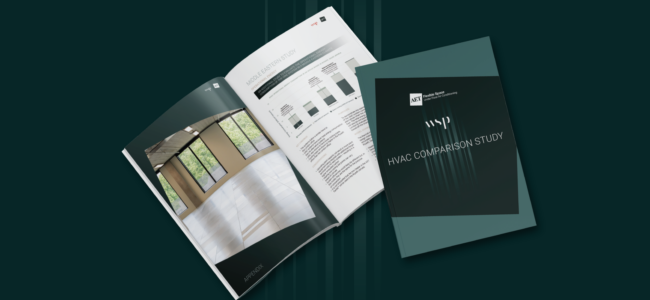
Recognising this, AET Flexible Space partnered with WSP to undertake a comparative study examining how different HVAC strategies perform across typical office refurbishment and new-build projects. Rather than focusing solely on equipment performance, the study considered wider building-level impacts including operational energy, upfront carbon, whole-life embodied carbon, capital cost, flexibility, wellbeing and circular economy indicators.
Looking beyond the plant room
Selecting an HVAC system is often viewed as an engineering decision. In reality, it influences far more than thermal comfort.
The study demonstrates how service zone requirements affect structural quantities, façade design and usable space, particularly in commercial office buildings where floor-to-ceiling height remains a premium.
Reduced service zones can lower material demand while simultaneously improving internal headroom and creating more flexible floorplates.
For refurbishment projects, these considerations become even more significant.
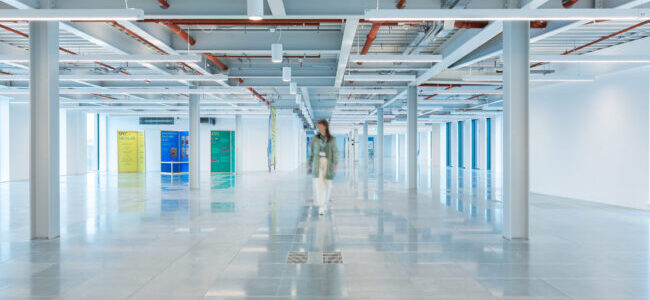
Many existing office buildings are constrained by limited floor-to-ceiling heights, making deep ceiling voids increasingly difficult to accommodate. Alternative HVAC strategies can help unlock these buildings by exposing existing soffits, preserving architectural character and simplifying future reconfiguration without extensive alterations to high-level services.
Carbon, cost and adaptability are increasingly connected
One of the study’s most interesting findings is that HVAC selection has implications well beyond operational energy.
By considering building-level impacts alongside system performance, the research identified opportunities to reduce upfront carbon, whole-life embodied carbon and operational energy simultaneously. In new-build scenarios, reduced slab-to-slab heights also generated measurable savings in structural materials and façade elements while creating opportunities to increase lettable space within the same overall building height.
These outcomes matter to different stakeholders in different ways.
For developers, they present opportunities to improve asset value while reducing carbon and construction costs; for architects, they offer greater design freedom through cleaner soffits, improved floor-to-ceiling heights and more flexible planning; and for M&E consultants, they reinforce the importance of evaluating HVAC strategies as part of the wider building design rather than in isolation.
Ultimately, occupants benefit too. Brighter, more spacious workplaces, improved indoor air quality, quieter environments and greater flexibility all contribute to creating offices that people genuinely want to use.
Designing better buildings starts with better information
As expectations around sustainability continue to evolve, the industry increasingly needs evidence rather than assumptions.
No single HVAC strategy will be appropriate for every project, but understanding the wider implications of those decisions enables better conversations at the earliest stages of design.
This HVAC Comparison Study offers an evidence-based contribution to that discussion, providing comparative data across refurbishment and new-build office projects to help project teams make more informed decisions.
You can download the executive summary of the report here.
This partner content has been supplied by AET Flexible Space

 August 19, 2026
  By BCO Media