The Flex Debate: Value v occupier requirements
Service not amenity will be the true deliverer of value for occupiers
 October 17, 2025



At a recent BCO London Committee seminar hosted at Storey at 100 Liverpool Street, industry leaders gathered to dissect one of the most dynamic themes in commercial real estate: flexibility in office space.
Moderated by BCO chief executive Samantha McClary, the panel featured experts from across the sector—Will Kinnear, director at HEWN, Becky Gardiner, head of Storey and managed workspaces at British Land, Christy Bowen, head of London offices and flex space – value at risk advisory at JLL, and Craig Owen, director of property and workspace at Legal & General—who explored the evolving landscape of flexible workspaces and the implications for occupiers, landlords, and investors.
Unpacking the f-word
With only a handful of attendees confident in defining the difference between flex, co-working, and managed space, Kinnear provided a clear breakdown of the terminology and structure that sit beneath the flex umbrella:
- Cat A space: The traditional landlord offering – empty, fitted only to a basic standard, ready for tenant customisation.
- Cat A+ or “product” space: A step up, featuring desks, tables, and chairs – ready for immediate occupation but without ongoing management.
- Managed space: Fully fitted space, often at floor or building level, with an additional layer of management provided on behalf of the occupier or landlord.
- Serviced or flex space: The most comprehensive model, encompassing everything from co-working and hot desking to private offices and amenity-rich environments, all operated under a flexible, service-led model.
Kinnear highlighted how flex had evolved into a spectrum of workspace options – from traditional leases to fully managed environments – each catering to different occupier needs and investment strategies.
However, while understanding the terminology is clearly important, end user Owen said the most important thing for an occupier was how well the space and the service was managed once you’re there.
What occupiers want
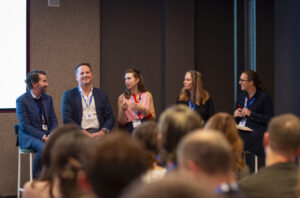
British Land’s Gardiner emphasised that successful flex models started with a clear grasp of what businesses actually want from their space. She explained how flexibility was not a single product but a spectrum of solutions, and that property owners must align operational delivery and amenity with occupiers’ expectations to create environments that truly add value for both sides.
Kinnear argued that amenity alone was no longer enough and that it was service that was now the differentiator. He highlighted the growing importance of hospitality-style operations and event-led programming, noting that while this evolution presented challenges for a traditionally static property sector, it also created opportunities for operators that can deliver meaningful, service-led experiences.
Gardiner agreed, saying that delivering amenities alone wasn’t enough. She said that operational excellence underpinned retention and renewal, and that occupiers were largely willing to pay a premium for that.
She warned, however that there was a ceiling on that price and that if a market emerged were occupiers were unwilling to cover rising service and operational costs, the financial model for fully managed or flex space could face real pressure.
The flex blur

With so many different solutions available for occupiers in the market and service becoming a buzz word across all forms of workspace provision, the panel turned its attention to whether the growing “hotelification” of offices risked diluting the distinct appeal of flex space.
Hewn’s Kinnear suggested that the industry was already moving toward a future where flex would no longer exist as a separate category but would become a standard component of every building – offering a mix of traditional, fitted, managed, and serviced space under one roof. He noted that while major landlords such as British Land and Landsec have successfully brought flex operations in-house, many owners still face challenges in finding the right partnership or operating model.
Gardiner agreed, explaining that British Land’s own portfolio reflected this shift, with occupiers increasingly seeking fully managed, hassle-free solutions – even larger businesses now preferring landlords to handle services traditionally managed in-house.
JLL’s Bowen said the market has already evolved into this spectrum, with what began as a divide between traditional leased and serviced space now merging, with fitted and managed solutions bridging the gap between the two.
From a valuation perspective, Bowen said this merging of traditional, fitted, managed, and serviced space within a single building had made assessing value increasingly complex.
In the past, Cat A space followed a predictable rental pattern, but today, variations in layout, fit-out, and flexibility can create as much as a 50% difference in rental values within the same asset. As landlords layer in more flexible offerings, said Bowen, the risk profile typically increases due to shorter lease terms – but so too does the potential return.
The evolution of how office space is provided is demanding new valuation approaches, said Bowen, as each level of flexibility commands a different balance between risk, yield, and revenue potential.
A flexible future

While the longevity of flex as we know it today was questioned in a market where flexibility is becoming the norm, the panel agreed that what made the sector so compelling was its ability to continually evolve.
Today the market fundamentals for the sector are strong, with occupancy steady at around 95% for leading operators. However, for operators to really deliver sustainable growth, they will have to focus even harder on understanding occupier wants – novelty amenity might turn heads but it won’t deliver loyalty – and will need a much clearer and reliable dataset on supply and demand.
The flex market today is unlikely to be the flex market of tomorrow. It is likely to consolidate, with smaller, less-resourced operators exiting, while those that combine hospitality, community, and operational excellence will flourish.
But ultimately, flex is here to stay. It’s not just a trend, said our panel, it’s an operational philosophy.
Five key takeaways:
- Flex is a spectrum, not a category: From Cat A to serviced space, flexible workspaces span a range of models tailored to different occupier needs and investment strategies.
- Service is the new differentiator: Amenities alone no longer suffice—hospitality-style service and operational excellence are now central to occupier satisfaction and retention.
- Flexibility has been normalised: The boundaries between traditional and flexible space are blurring, with flex increasingly integrated into standard building offerings.
- Valuation is more complex: As flexibility increases, so does the complexity of assessing value—requiring new approaches to balance risk, yield, and revenue.
- Flex isn’t a product, it’s a mindset: More than a product, flex represents a philosophy of adaptability, shaping the future of workplace strategy through continual innovation.
With thanks to British Land for kindly sponsoring this event.


 By BCO Media