EXPERT INSIGHT: The discipline of doing less
BCO member Ben Myers, associate director and studio lead at Morris+ Company, shares his insights on delivering more with less at 3 Sheldon Square.
 April 30, 2026


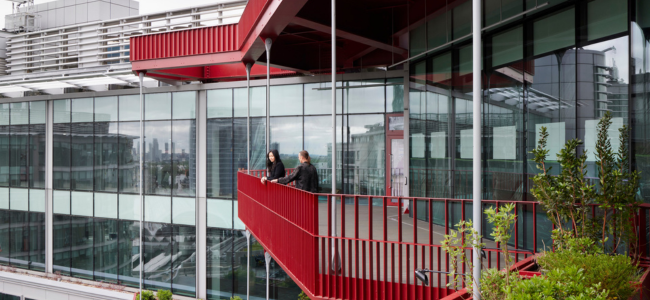
3 Sheldon Square © Jack Hobhouse

Ben Myers, Associate Director + Studio Lead, BSc (Hons) DipArch ARB RIBA AaPS
A whole generation of office buildings, from the mid-1990s to the late 2000s, is approaching a critical moment. Many are now entering refurbishment cycles where the default response is “deep retrofit”, often resulting in the wholesale replacement of façades that remain technically serviceable.
Their challenge is not obsolescence, but taste.
Architectural value is cyclical, and this helps to explain the response. Buildings move from contemporary, to dated, to rediscovered. Victorian warehouses were once liabilities; postmodernism was dismissed before being revived. Early 2000s high-tech commercial architecture now sits in its most vulnerable phase, technically ageing but not yet culturally revalued.
For buildings of this type, the default response is replacement. Replace the façade and everything else follows. Capital cost increases, additional floors are introduced to recover value, material use expands, and carbon rises.
The partial retrofit paradox
This is the partial retrofit paradox: retaining the frame while eroding carbon savings everywhere else. More material, more cost, more carbon.
The driver is often aesthetic rather than technical. Curtain wall systems from this era were not naive. Double glazing, considered U-values and solar control characteristics were standard. By today’s benchmarks they are imperfect, but often capable of meeting a performance sufficiency threshold with targeted upgrades.
Industry tends to design to optimisation, but sustainable retrofit should ask a different question: can we work with it? The question is whether replacement is necessary. Does a 25-year-old façade need to be replaced to reposition an asset?
British Land’s 3 Sheldon Square is typical of this building type. The brief was familiar: strip the building, replace the services, improve performance, reposition the asset.
The approach was to add rather than replace. External balconies introduce amenity space and solar shading. Planting adds a biophilic layer. Interventions reinterpret the existing façade rather than removing it, establishing a new identity through contrast.
Making the commercial and carbon case
The outcomes are measurable. LETI targets for 2030 sit at 350 kgCO₂/m². Many high-performing new-build schemes remain above 500 kgCO₂/m². Partial retrofit schemes involving façade replacement and extension typically fall between 250 and 400 kgCO₂/m². 3 Sheldon Square was delivered at 125 kgCO₂/m².
There is also a clear commercial case. The scheme avoided wholesale replacement and concentrated investment on high-impact elements. The all-electric, BREEAM Outstanding building was delivered with a minimum 15-year life extension at approximately £160 per sq ft GIA, well below the typical cost of re-skinning and extension.
Concerns about market acceptance did not materialise. During construction, heads of terms were agreed with a blue-chip occupier for 83,000 sq ft at competitive rents.
The default response is often wholesale transformation. It does not need to be. There is a large cohort of assets in a similar position. These conditions can be seen at Canary Wharf, where the first generation of early towers is now entering its refurbishment cycle. The same decisions are being made at scale, and the cumulative impact will be significant.
The decisions taken over the next five to 10 years will determine whether retrofit delivers meaningful carbon reduction, or represents a significant missed opportunity at the point when it matters most. If retrofit is to realise its potential, the threshold for replacement has to be higher. The outcome should not be determined by what we can build, but by what we choose to replace.
What is sometimes described as “radical retention” is, in practice, often just a more rigorous application of judgment. British Land’s 3 Sheldon Square demonstrates that this approach is viable. We are not short of buildings. We are short of restraint.
Ben Myers is an associate director and studio lead at Morris+Company and a BCO member.


 By BCO Media