Navigating unprecedented uncertainty
Industry leaders shared their insights at this year's BCO Conference in Edinburgh on how to build for an uncertain future
 August 28, 2026


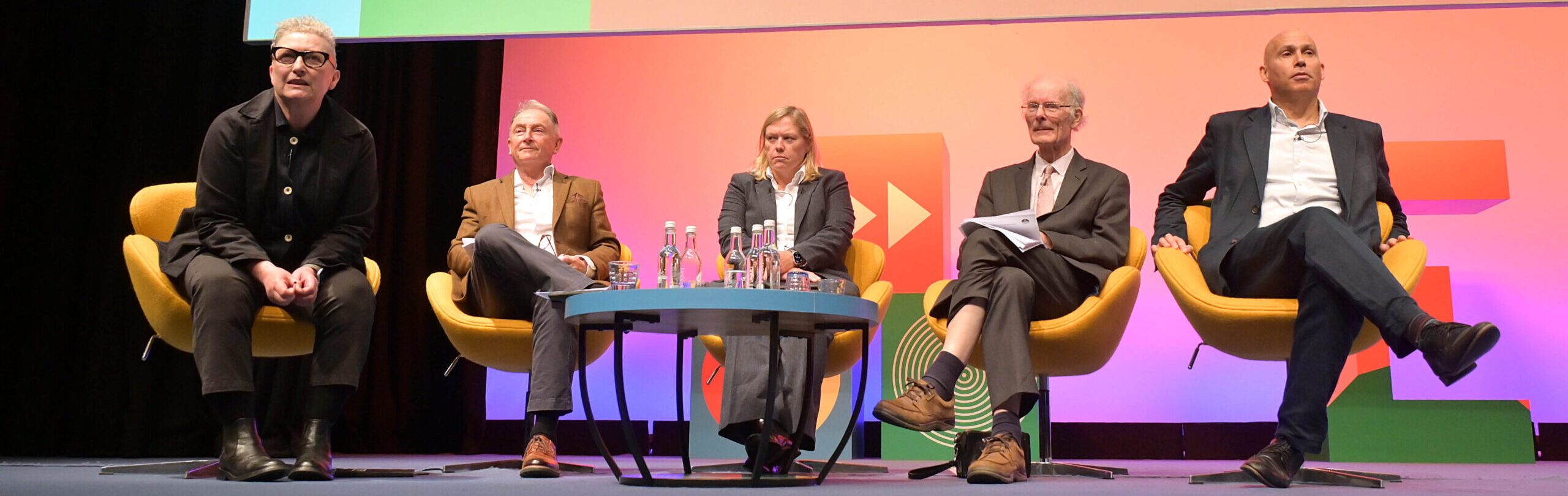
BCO Conference 2026 insights: How do we build for an uncertain future? How do we create spaces for a society that doesn’t know what it will need from workplaces in a year, let alone a decade? How do we design for a revolution?
Three complex questions with one simple, and maddening, answer. We just don’t know yet. The good news, though, is that we can start to hazard a pretty good guess by following the money. All $5.2tr of it.
So said the University of Strathclyde’s Gillian Docherty as she challenged us to consider what might be the building that holds the most value in a city by 2040. Not the most expensive, not the tallest, either: the one that creates the greatest economic value.
The building that attracts the best talent and becomes the defining asset of its generation. And while we still might not know exactly what that building will be, or look like, we can be pretty certain what revolution it will be built to serve.
“McKinsey predicts that $5.2tr will be spent on AI processing infrastructure by 2030,” said Docherty. “Whenever humanity spends trillions of dollars on something, it doesn’t create a new market, it creates a new era,” she added.
Offices will need to earn their existence
“AI has changed the rules completely, not incrementally but fundamentally. It is changing everything and while most of our careers have been built on analysing what already exists, the most valuable building of the future probably hasn’t been built yet.”
Every technical revolution leaves behind a dominant building type. A manifestation of economic power. The industrial revolution created the factory, the rise of the corporation created the office tower, the internet created the data centre. And while the building that will go on to become the defining asset of the AI generation might not yet have emerged, that doesn’t mean the real estate sector can’t start to prepare for it. And that starts with asking the right questions.
Most conversations around AI still focus heavily on jobs. But while questions around whether AI will replace people and productivity and how and when it will automate work are important, Docherty argued that the real estate sector would be better served by focussing instead on how AI will change where value lives. “When value moves, capital moves,” she said. “And where capital moves, property, cities and infrastructure move.”
Offices will need to earn their existence more than ever as AI makes working from home increasingly productive, she said. If people are going to travel and spend £7 on a coffee to sit next to someone they could have called on the phone, the experience when people get there has to be worth it.
We will see a battle between destination and experience workplaces where average, forgettable space becomes increasingly vulnerable and workspaces that become less like factories and more like universities and laboratories thrive.
AI will increase the net worth of collaborative workspaces
The value propositions at universities and in education settings will also need to shift to make sure future generations are ready for this new era. “Revolutions like this essentially take a layer of white-collar occupations out of the system,” added political scientist Sir John Curtis.
“AI will place a premium on creativity. So, not only do universities and academic institutions have to embed AI into the curriculum, but they also have to emphasise the power of new thinking and the ability to be creative.”
It is this creativity, Docherty said, that best-designed workplaces of the future will foster. Far from sounding the death knell for the office, AI is likely to increase the worth of collaborative workplaces that are fit for modern purpose.
“We have spent years building technology that eliminates distance; railways, telephones, computers, the internet. Every one of them made cities stronger because technology repeatedly increases the value of human interaction. Talent attracts talent, ideas attract ideas and innovation attracts innovation. Build buildings that will help people perform better. That’s the value.”



 By BCO Media