Sponsored by:

Learn more about these five finalists in the Fit out of Workplace category here:
Nigel Clark is Technical Director with Hilson Moran and has been involved in the design and construction of buildings for over 39 years.
His early career was in the public sector, where he was involved in the design of large scale Educational, Leisure, and Court Buildings. Since joining Hilson Moran he has been involved in major commercial schemes for both developers and end users, including some of the tallest buildings in the UK.
Nigel became Chairman for the London and South East BCO Judging panel in 2012. As the Chair of the BCO Awards National Judging Panel in 2018 he describes the judging process as a great opportunity to see the best office buildings that this country has to offer, and a tremendous privilege to receive presentations from the entrants.
Learn more about who joined Nigel on the BCO National Awards Judging Panel.
Book online for the The BCO National Awards taking place on 2 October 2018.
Sponsored by: Jackson Coles
Learn more about these five finalists in the Commercial Workplace category here: http://ow.ly/173930lF0zb

Sponsored by:

Learn more about each of these five finalists in the Corporate Workplace category here: http://ow.ly/dPZ030lEZQ3
In July’s CIBSE issue, Elementa’s Ed Garrod explains the importance of workplace health and wellbeing and the research behind the recently published BCO Wellness Matters Report.
On page 28-29:goo.gl/c2ZTpg
Short teaser snippet of Ed Garrod of @elementa_uk speaking at the launch of #BCOwellnessmatters. Read his latest piece in @CIBSEJournal: https://t.co/VAYVKonn5S
Download the full report: https://t.co/pVSrXIfdIi#wellness#workplacewellbeingpic.twitter.com/fFd0yH0aMn— BCO (@BCO_UK) August 7, 2018
Last month we announced the winners of the BCO Photo Berlin competition run by Art Acumen during the Annual BCO Conference. The overall winner, James Hindle of Tate Hindle received the following comments from the judges:
“A well observed shot and very balanced.”
“Powerful story telling, the photographer alludes to the people behind the façade.”

The inaugural competition awards James with a luxurious two night stay at the Ritz Carlton Berlin (where BERLIN: BE BOLD took place) and a highly sought after Stuart Redler print (examples below)

Working exclusively in black and white, Stuart Redler photographs architecture, people and animals. His eye-catching work derives from photographic excursions throughout Europe, remote villages in Africa, Asia, Greenland and more. Stuart takes photographs of iconic buildings from a unique and innovative view point. The intense contrasts of shades of black and white and his use of strong light gives his photographs a stark and unique quality. Architectural features take on abstract forms. Buildings become landscapes of pattern and texture. View Stuart’s portfolio here: http://www.stuartredler.com/architecture/
Redler has received many awards, including six from the Association of Photographers, who awarded him a Gold Medal in 2000 for his portfolio of Architectural Images. He has also received Graphis, PDN New York and Communication Arts Awards, amongst others. As well as appearing in various private collections, his work is included in the permanent collection at the National Portrait Gallery in London and has been exhibited at the Victoria and Albert Museum, London. Stuart will be presenting one of his iconic photographs to James at the BCO President’s Lunch in September
The winning image for BCO Photo Berlin also came first in the ‘Diversity’ category, earning James a category cash prize of £150 which he has kindly donated to The Rumba Foundation:

James has been a BCO member for 15+ years. The Rumba Foundation is run by his wife Fiona Hindle. Fiona had been a trustee at the University of Cambridge Veterinary School Trust and about five years ago set up The Rumba Foundation, named after their first Burmese cat.
Mrs Hindle said: “Our remit is to support clinical care for companion animals. We can guarantee that all donations go directly to the causes we support, so we make significant and immediate impact. Since we formed Rumba we have raised almost £100,000 through events using our contacts across the property and construction sector with many of them BCO members.”
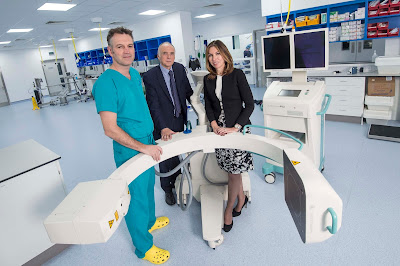
“What Rumba is doing is helping change veterinary oncology, no question!” -Professor Nick Bacon, Clinical Director of Oncology, University of Surrey.
“One of the major projects we have funded to date has been buying a C-Arm (above) worth £60 000 which is a live x-ray machine and accompanying lead gowns for the Fitzpatrick Referrals Oncology and Soft Tissue Hospital (FROST). Through our donation this has allowed them to not charge patient owners for the use of the equipment so not only are patients benefiting from the most pioneering equipment, it also means that their animals are having treatment that the owners might otherwise not be able to afford. Most importantly, the world-class oncologists vets at FROST have monthly meetings with the oncologists doctors at the local Royal Surrey Hospital , so there is considerable crossover and learning for animals and humans. It is now the busiest C Arm in the UK and in use daily which is why we recently bought more lead-lined gowns.”
James said “I think what we have achieved shows what a fantastically supportive and charitable sector we work in and many BCO members have played a large part in what Rumba has achieved.”
Join the conversation on social media: @BCO_UK
#BCOconference #BCOphotoBerlin #RCMemories
Visit the Rumba Foundation website and Just Giving Page: www.justgiving.com/therumbafoundation

At the BCO annual general meeting last evening, I was honoured to pass on the mantle of the BCO presidency to Katrina Kostic Samen, founder and managing partner of KKS Strategy. I know she’s got big plans for the organisation.
Before I get back to my everyday life at Make, though, I’d like to reflect on my time with the BCO. Since being nominated to become junior vice president in 2015, I’ve had a fantastic few years with the higher echelons of the BCO. My first task was to help shape and lead the last plenary session of the 2016 conference in Amsterdam; after that it was to organise the 2017 conference in London. A monumental task, I quickly realised!
Despite the plentiful challenges of pulling together a 3-day event for over 500 delegates in a city everyone thinks they know already, I’m confident the ‘London Refocused’ conference was a great success. We had tours of more than 40 workplaces and talks from celebrated designers, experts and thinkers such as Juliette Morgan, the now-former head of the Futures Group at Cushman & Wakefield, former US diplomat James Rubin, workplace transformation expert Despina Katsikakis, and Paul Chong, director of IBM’s Watson Group. And of course Lord Foster as the keynote speaker – an absolute highlight for me and many others.
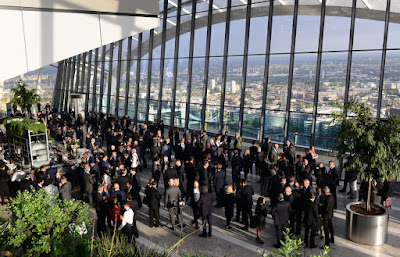
BCO 2017 opening drinks at Sky Garden at the Walkie Talkie © Stewart Writtle
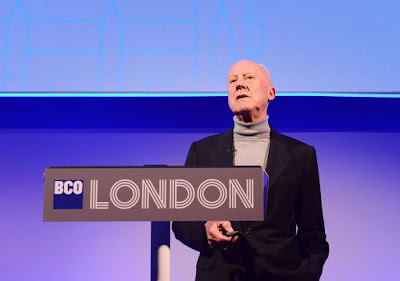
Lord Foster at BCO 2017 © Stewart Writtle
Key themes to come out of the event included placemaking, flexibility and sustainability, as well as the influence of technology and the growing trend of wellbeing in commercial environments. These are all topics we’re thinking about at Make, and I’m excited to see how all of us in the industry can contribute to evolving and progressing them in the coming years.
Since the conference, I’ve visited BCO regions around the UK to meet with the committees, attended key events such as the President’s Lunch and the Annual Dinner, and helped create and oversee the NextGen competition, ‘The Office of 2035’. With regards to NextGen, I think it’s incredibly important for us to bring forward the next generation and provide the BCO with a ‘refresh’ to encourage younger and more diverse members.
In August 2017, during a visit to the Make Sydney studio, I gave a breakfast presentation at Cushman & Wakefield on the key takeaways of the London conference. The success of this event, and seeing how interested people were in what’s happening in the UK, got me thinking about the importance of increasing the BCO’s global reach. It’s evident that we are seen as leaders in workplace design around the world, so we must keep working to remain that way. I think expanding our presence beyond our borders will be an important part of that.
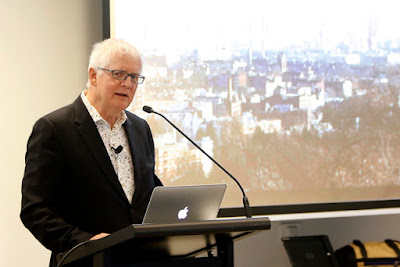
At Cushman & Wakefield in Sydney © Quentin Jones
In February of this year, I also launched the President’s Survey to help shape the BCO’s agenda going forward. The feedback – from BCO members – was incredibly instructive. A number of common themes surfaced, from which we formulated four key recommendations that we presented to the board: Increase gender and ethnic diversity
Explore avenues of greater global engagement
Increase consultation with members
Increase use of technology, including digitisation of the BCO Guide to Specification
Richard Kauntze, BCO chief executive, has said they will be progressing the recommendations in the weeks and months ahead.
At this year’s successful Berlin conference, Katrina announced her plans to focus on designing more inclusive workplaces as well as to push for greater diversity within the BCO itself, causes I both applaud.
As for me, I believe that if the BCO is to remain at the cutting edge of office design, particularly in a post-Brexit landscape, it will have to adapt quickly and be responsive to members’ and market demands.
It of course remains to be seen what the full effects of Brexit will be, but for the time being, I hope the BCO will show the world that we intend to stay a global hub for business, and will keep helping to create world-class workplaces for companies that want to be here.
At next year’s Copenhagen conference, we’ll delve into work-life balance, another important issue in our modern life. I’m looking forward to that as well.
But for now, it’s been an absolute honour to have been a part of this institution, which has formed the bedrock of UK workplace design guidelines for nearly three decades. It’s produced fantastic work over the years, but I firmly believe that the best is yet to come, and wish Katrina the very best of luck for the coming year.
Originally published on 12.07.2018
By Ken Shuttleworth on www.makearchitects.com
By Thomas Watling, Senior Consultant at Deloitte, Contributing Author, Fast and Slow Buildings

Intelligent Buildings and the Internet of Things (IoT) in real estate are much talked-about, and for good reason.
Analyst predictions suggest that there will be over 10 billion connected devices deployed in real estate by 2020.
Watching this trend, the British Council for Offices (BCO) has just published a new report on intelligent buildings: “Fast and Slow Buildings: Responsiveness through technology and design”. It was authored by the building service engineering firm Max Fordham, for which Deloitte was a contributing author. BCO members can read the full report here.
In this blog, I’ll explain what’s meant by building ‘intelligence’, and share four things we’ve learnt from our work in the intelligent buildings space.
Intelligent buildings contain connected networks of sensors and actuators, which integrate with traditional building systems (such as lighting and air conditioning) to continually improve and automate the operations of the building in question.
The network of sensors might include occupancy tracking which measures the ‘busyness’ of the cafeteria and suggests when to visit.
There could be a set of sensors that monitors the indoor environment and the efficiency of air conditioning.
A corresponding set of actuators would automatically optimise energy consumption and make the working environment more comfortable for each individual employee.
Automated systems of sensors and actuators drive operational efficiency, reduce cost and environmental impact, and improve the employee experience, which in turn generates value by improving productivity.
We’ve learnt a lot from our discussions with clients and vendors. Here’s four things you should know:
#1 Older buildings can be intelligent too
Often the term ‘Intelligent Building’ is applied to eye-catching new-build headquarters, but not to pre-existing buildings. It’s estimated that 85% of building stock that will exist in 2050, is already in existence today (Existing Homes Alliance). Thus, there’s a significant opportunity to leverage building intelligence by retrofitting existing spaces with intelligent systems, in addition to the opportunities presented by intelligent new builds.
#2 There’s more to intelligence than connecting building subsystems
Historically, traditional building subsystems could be centrally controlled and were connected with one another. But a building being connected doesn’t equate to it being intelligent. Data from these subsystems needs to be shared and augmented by other sensor data, so that insight provided by this data can help solve wider business problems. Knowing where to find a free desk is useful. But what if your building directed you to sit next to a previously unknown colleague with shared interests to try and create an opportunity for serendipity – that’s intelligent.
#3 Don’t use technology for the sake of it – focus on business problems instead Deloitte Digital’s Chief Disruptor, Ed Greig, regularly reminds innovation novices and veterans alike to “fall in love with the problem, not the solution”. It’s easy to get excited about sensors and touch screens, but this should always be underpinned by a clear understanding of the cost and benefit drivers that influence real estate space, as well as a deep understanding of the building users’ needs.
#4 Treat changes as experiments
How do you measure the value of a new real estate technology? And how will you act when you’ve measured this value? When talking about the Internet of Things, we refer to the ‘information value loop’. A sensor creates data, which is communicated, aggregated and analysed. Then, someone or something has to act on the outcome of the analysis. The process starts over, measuring the impact of the new change. Realising the value of an intelligent building requires an iterative approach, where data communicates the value of the work and informs future decisions.
For information about how we’re helping clients understand Intelligent Buildings as part of the Global Consulting “Future of Work” agenda, contact Rob Scopes. For information about the Internet of Things, contact Ben Steward.
The British Council for Offices (BCO) has released “Fast and Slow Buildings: Responsiveness through technology and design”, for which Deloitte was a contributing author. BCO members can download the full report here.
The results are in for the BCO Photo Berlin Instagram based photography competition for all BCO delegates, devised and run by Art Acumen. Conference delegates were invited to take photographs of Berlin over the course of the event capturing the themes:
Art Acumen are proud to present the winners of BCO Photo Berlin, the inaugural Instagram photography competition for BCO’s annual conference.
“I would like to congratulate the winners and highlight the overall high standard and diversity of entries. We wanted to create a project without barriers, that was easy to participate in and that communicated thoughts and observations beyond the BCO Conference. As well as providing us with a visual thought-map of the weeks’ activities, we hope that the photography competition added a layer of contemplation, art and poetry to people’s experience as they explored the city.”
–Catherine Thomas, MD, Art Acumen
CONGRATULATIONS to the following winners!

OVERALL WINNER
DIVERSITY – WINNER

OVERALL RUNNER UP
INCLUSION – WINNER
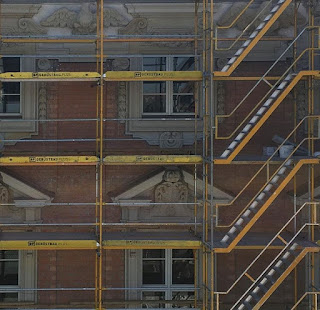
INNOVATION – WINNER
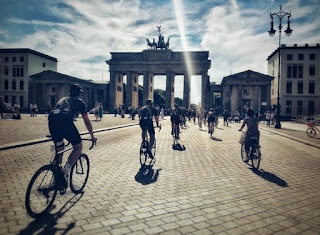
CONNECTION – WINNER

DIVERSITY – HIGHLY COMMENDED
1) James Hindle, Tate Hindle
Overall winner. Diversity – winner.
Judges’ comments:
A well observed shot and very balanced.
Powerful story telling, the photographer alludes to the people behind the façade.
2) Stuart Pledge, Mason Navarro Pledge
Overall runner-up. Inclusion – winner.
Judges’ comments:
Great juxtaposition between the old and the new.
Good composition.
Technically one of the best pieces.
3) Mark Simpson, BDP
Innovation – winner.
Judges comments:
The composition is very good.
The photographer has been very innovative showing the layering of history.
4) David Blair, TP Bennet
Connection winner
Judges’ comments:
Great sense of vibrancy and movement, connecting people to one Berlin’s most iconic structures.
Technically very good.
Link back to people, which is what architecture is all about.
5) John Wright, Stride Treglown
Highly commended
Judges’ comments:
Very powerful image.
Great composition.
Criteria for judging:
Adherence and appropriateness to theme
•Innovative way of delivering message
•Creativity
•Overall artistic impression
•Composition
•Evokes an emotional response
•Judges personal response
“As most photographs were taken with a smartphone, more emphasis was placed on storytelling and originality than photographic technical skills.”
Thank you

#BCOphotoBerlin is an Instagram based photography competition for all BCO delegates, devised and run by Art Acumen, the leading art consultancy. They invite you to take photographs of Berlin (inside and out) over the course of the conference capturing the themes:

Katrina Kostic Samen, KKS Founding Partner, BCO Senior Vice President
Katrina has built a practice which is a recognised leader in workplace strategy and interior architecture, reflected in many achievements and awards over the last 15 years. Katrina’s belief in pushing boundaries, striving for excellence, and expanding the professional body for commercial offices is represented in her fundamental principle: Be Creative, Add Value, Have Fun!
Michael Pritchard, CEO of Royal Photographic Society
Michael is Chief Executive of the Royal Photographic Society, an educational charity with Royal Charter founded in 1853. Prior to this he was a Director at Christie’s, where he was the international business director and member of the senior management team.

Grant Smith, Leading photographer
Grant Smith has an extensive knowledge of London’s architecture and is commissioned by all sectors of the industry including design companies, magazines, architects, contractors and engineers. His body of work includes some of the world’s iconic structures: the Pont de Normandie, second Severn Crossing, the Sydney Harbour tunnel, the Millennium Bridge, the Millennium Dome and the Gherkin in London. He is currently photographing London’s newest skyscraper, The Scalpel.
Stuart Redler – Award winning photographer
Working exclusively and black in white, Stuart Redler photographs buildings from all over the world. He has received many awards, including six from the Association of Photographers, who awarded him a Gold Medal in 2000 for his portfolio of Architectural Images. He has also received Graphis, PDN New York and Communication Arts Awards, amongst others. As well as appearing in various private collections, his work is included in the permanent collection at the National Portrait Gallery in London and has been exhibited at the V&A Victoria and Albert Museum, London.
Catherine Thomas – Art Acumen Founder
Catherine is the creator of #BCOPhotoBerlin and Managing Director of Art Acumen, a consultancy providing art services to corporate, public and private clients. They specialise in curating and commissioning art collections, devising bespoke creative projects and place-making through public art programmes. For the past 16 years Catherine has delivered visionary art strategies and inspirational art commissions for many corporate, public and private clients, building a formidable portfolio and excellent reputation.

Elissaveta Marinova – Editor at OnOffice
Editor at OnOffice. Born in Bulgaria, raised in Morocco, “matured” in the UK, Elissaveta is Editor for OnOffice. Her career started in the field of architecture and design where she developed a talent for creative thinking and an eye for aesthetics. In 2014, she found her calling in design journalism.
To enter – Upload your photo via Instagram using the hashtag #BCOphotoberlin or email to BCOphotoberlin@artacumen.co.uk. This is an Instagram competition and judging will take place from INSTAGRAM and emailed entries only. Entrants are encouraged to share their entries elsewhere online but only Instagram and emailed entries are officially accepted and judged. There is no limit on how many images you can enter. The final deadline for submission is 31.05.18. 5-Star Hotel Vouchers and cash prizes are up for grabs! Also up for grabs is a highly sought after Stuart Redlar print PLUS all winners and highly commended will be invited on an architectural photographic tour of London by Grant Smith.

 August 28, 2026
  By BCO Media