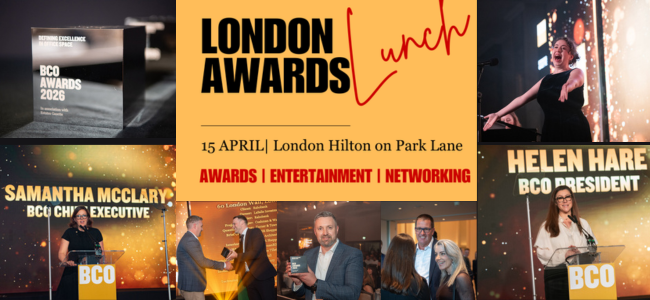
The winners of the British Council for Offices London Awards 2026 have been announced, recognising six outstanding workplace projects that demonstrate design excellence, meaningful sustainability and a strong focus on people and place.
The BCO regional award winners for London are:
- Best Corporate Workplace: Deutsche Bank, 21 Moorfields
- Best Commercial Workplace: Stonecutter, 1 Stonecutter Street
- Best Refurbished / Recycled Workplace: 76 Southbank
- Best Fit Out of Workplace: Rabobank, 60 London Wall
- Best Project up to 2,500m²:170 Piccadilly
- ESG Award: TBC.London, 224-226 Tower Bridge Rd
This year’s winners mark a decisive shift away from demolition‑led development towards long‑term urban stewardship, with projects such as 76 Southbank, delivered by AHMM for Wolfe Commercial Properties, and TBC.London, developed by FORE Partnership with Stiff + Trevillion, demonstrating how existing buildings can be re‑engineered into world‑class workplaces through material reuse, architectural restraint and net‑zero ambition.
Angela Joseph, development director at Brookfield Properties and chair of the BCO London judging panel, said: “This year’s projects show a real maturity in how the industry is working. Teams have taken on enormously difficult sites; building over live rail infrastructure, working sensitively with listed fabric, and turned those constraints into the driving force behind better design. I’ve been impressed by the brave and thoughtful choices made by teams, from reusing structural steel to making sure that all workspaces work harder to achieve a range of uses for occupiers and the highest possible sustainability standards. These are buildings shaped by long-term thinking rather than short-term solutions.”
Integrated design, where architecture, engineering and interiors were conceived together, emerged as a recurring practice across the winners. BCO Judges commended the collaborative approach at 21 Moorfields, led by WilkinsonEyre with tp bennett and a multidisciplinary engineering team, as well as at Stonecutter, where tp bennett, Hoare Lea and CO‑RE aligned sustainability, structure and tenant experience from an early stage to deliver a fully electric, highly sustainable commercial workplace.
Social value and ESG beyond compliance also differentiated this year’s winners. Projects were recognised not only for environmental performance, but for how teams invested in skills, craft and community. Judges pointed in particular to TBC.London’s pioneering approach to reclaimed steel and bricklaying training, Stonecutter’s focus on education and community engagement, and the public realm improvements delivered at Lendlease’s Moorfields and along the South Bank.
Clare Ashmore, chief operating officer at Parkeray and chair of BCO London committee, said: “This year’s London winners show that wellbeing is no longer a nice‑to‑have in workplace design, but central to how offices are conceived and delivered. With ESG shaping everything from architecture and construction to long‑term social impact, these projects demonstrate how workplaces can support people, strengthen their surroundings, and still perform commercially. They set a strong and inspiring benchmark for the next generation of London workplaces.”
Samantha McClary, chief executive of the BCO, added: “What these London winners demonstrate is a wider shift in mindset across the office sector. Faced with unprecedented economic, environmental and social change, the industry is showing it can adapt with confidence, investing in quality, reuse and long-term value. The winners also reinforce the role of the office as critical infrastructure for cities like London by supporting productivity, wellbeing and connection.”
Please see below for full list and description of winning projects:
Best Corporate Workplace: Deutsche Bank, 21 Moorfields
Described as “a building that is a bridge”, 21 Moorfields is a landmark corporate headquarters delivered above a complex operational rail interchange in the City of London. The project combines architecture, engineering and interiors in a highly integrated way, creating a flexible, future-ready workplace while significantly enhancing the public realm with new routes and public spaces linking Moorgate and the Barbican. Judges praised the project as a market‑leading example of user-focused design delivered under extraordinary constraints.

Best Commercial Workplace: Stonecutter, 1 Stonecutter Street
Stonecutter impressed the judges with its thoughtful response to context, drawing on the area’s historic diamond‑cutting heritage to inform its design. The all‑electric building delivers strong environmental performance alongside a clear social value agenda, particularly its focus on education and community engagement. Fully let ahead of completion, judges described the project as a highly sustainable workplace designed to stand the test of time.

Best Refurbished / Recycled Workplace: 76 Southbank
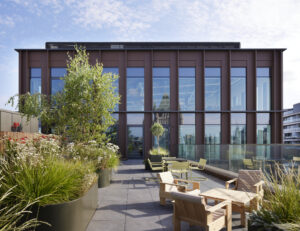
76 Southbank is an exemplary refurbishment and extension of Sir Denys Lasdun’s final major building, delivered with exceptional care and attention. Judges praised architect AHMM for its sensitive material approach, including the replication of the original precast granite panels, and the transformation of the building’s relationship with the public realm through new entrances and generous riverside terraces. The result is a world‑class office that reconciles heritage conservation, net‑zero ambition and civic presence.

Best Fit Out of a Workplace: Winner: Rabobank, 60 London Wall, Highly Commended: Pension Insurance Corporation (PIC), 22 Ropemaker Street
Rabobank’s fit out was recognised for its calm, refined design and strong emphasis on sustainability and wellbeing. Extensive material and furniture reuse underpin aspirations for BREEAM Outstanding and WELL Platinum, while communal spaces sit at the heart of the workplace. PIC was highly commended for its thoughtfully executed office, where flexible layouts, generous terraces and embedded wellbeing spaces support long‑term adaptability.
Best Project up to 2,500m²: 170 Piccadilly
170 Piccadilly was praised for successfully balancing heritage with modern workplace standards. Working sensitively alongside a listed building, the project unlocks new amenities, including a rooftop terrace and end‑of‑trip facilities. while delivering high environmental performance. Judges described it as a model example of how heritage buildings can be adapted to support contemporary working.
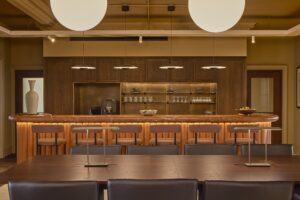
ESG Award: TBC.London, 224–226 Tower Bridge Road
TBC.London set a new benchmark for ESG-led development. The judges highlighted its pioneering reuse of reclaimed steel through “urban mining”, its handcrafted brick façade delivered via a training programme, and its commitment to net‑zero carbon in operation. Beyond the building, the project supports local communities through affordable spaces, a curated food offer and partnerships with Southwark Council. Judges praised it as a project that genuinely goes beyond box‑ticking.
The London winners will go on to compete at the BCO National Awards in October.
The Gold sponsors for this year’s BCO Awards are: AET Flexible Space and Troup Bywaters + Anders. The London regional sponsor is Wilmott Dixon. Estates Gazette is media partner.
Please find a link to images of the winners here.
 September 21, 2026
  By BCO Media