The CBD is dead, long live the MXD
BCO's Samantha McClary on the power of our regional office markets
 November 24, 2025


If you’ve been keeping an eye on the regional office market, you’ll know something interesting is happening. In cities like Leeds, Reading and Cardiff, demand for office space is picking up pace, signalling that far from being obsolete, the regional office still has plenty to offer.
In Leeds, Q3 office take-up reached 156,675 sq ft across 33 deals, marking a 7% year-on-year increase. Prime rents are edging up to £46 per sq ft, with new schemes quoting £50. And flexible workspace? That now accounts for 66% of demand in regional markets, up from 54% in 2020.
But there’s a bigger story to tell. This rising demand is doing more than just pushing up rents. Developers and investors are responding by bringing forward new schemes, often as part of mixed-use masterplans that combine workspace with homes, shops, and public realm. And offices are the cornerstone in these wider regeneration projects.
Why? Because they are public-facing symbols of confidence. They attract occupiers, investors, and footfall. Office workers enliven places. They support retail, bring shoppers and diners, and often anchor regeneration, with pre-lets and early leasing activity helping to de-risk and accelerate neighbouring development. In short, offices bring pace, visibility and purpose to regeneration efforts.
Let’s look at some examples of how this is playing out across regional centres, and yes, sorry, not sorry, they’re all BCO award-winning projects.
The regenerative power of workspace
This Foster + Partners designed building has become a benchmark for how private investment can unlock strategic urban centres. Cardiff’s office market has responded in kind, with annual take-up reaching its highest level since 2017 and headline rents rising to £30 per sq ft.
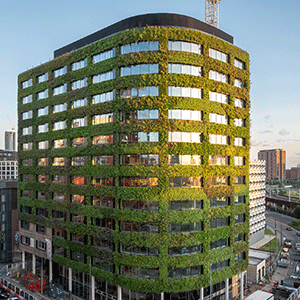
Eden (pictured), Salford, is part of the city’s £1bn New Bailey masterplan which is delivering more than 1m sq ft of commercial space and more than 1,000 homes. Winning our ESG award, Eden’s green credentials are front and centre, with cutting-edge design and a BREEAM ‘Excellent’ rating. As a result, the building is attracting forward-thinking tenants that care about sustainability.
The building is also giving back to its surroundings in other ways. The building’s ground-floor social hub is now home to Spice & Grind, a locally owned coffee shop, and the development has introduced cycle lanes and a living wall at a nearby primary school. According to the council, Salford is tracking the highest productivity in Greater Manchester with ambitious plans to deliver 40,000 new homes and jobs by 2040. Offices like Eden are helping drive that growth.
In Reading, One Station Hill (pictured, top) has attracted major occupiers like PepsiCo, PwC, and NewFlex, with PepsiCo relocating 650 employees from Whitley to the new building next to the train station. The development is part of an £850m mixed-use scheme that includes 625,000 sq ft of office space and 1,300 homes. Designed to achieve BREEAM ‘Outstanding’ and WELL Platinum ratings, Station Hill is setting new standards for ESG-led commercial development and is expected to set new rental benchmarks in tandem, as Reading continues to see demand from financial, tech and healthcare sectors strengthened by its new connections via the Elizabeth line.
Welcome to the MXD
These examples represent a new model. The old Central Business District is gone. Welcome to the MXD, the mixed-used district. Today’s regeneration is multi-use by default, with offices, homes, shops, culture and public realm working together to create ecosystems of growth and community.
Offices are the catalyst for inward investment and a means of achieving a better sense of place and purpose. And it’s a virtuous circle: thriving, connected areas with a strong sense of community and identity attract top-tier occupiers. These occupiers, in turn, reinforce the vibrancy and resilience of the district.
The lesson is clear. Through stakeholder and community engagement, offices can not only reflect a place; they can help define its future.
So don’t just ask what an office is. Ask what it does. It drives regeneration. It builds community. It signals belief and pride of place. And in cities like Sunderland, Salford, Cardiff, and Reading, offices are doing all of that and more.
Samantha McClary is chief executive of the BCO
This article was first featured on Green Street News



 By BCO Media