
ENTRIES CLOSE NEXT WEEK FRIDAY
We know it’s not easy to win a BCO Award. The submission requires effort, precision, time, teamwork and skill. Each year entrants need to beat stiff competition, but when they finally get to hold one of the coveted BCO trophies, they can do so safe in the knowledge that they have achieved something outstanding.
Winning a BCO trophy is something that every team member can be proud of and boast about. It provides a focus for others to study, appreciate, and aspire to in their own projects and workplaces.
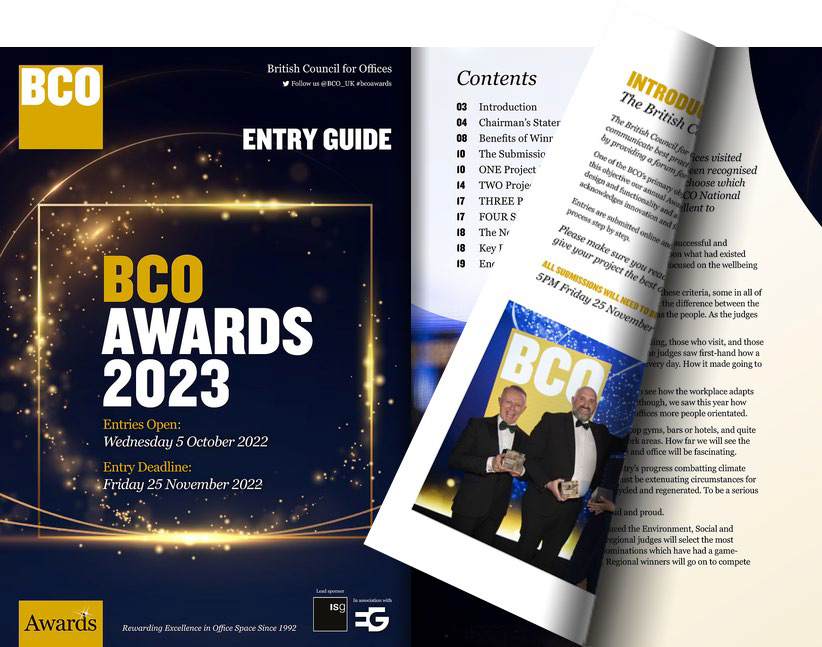
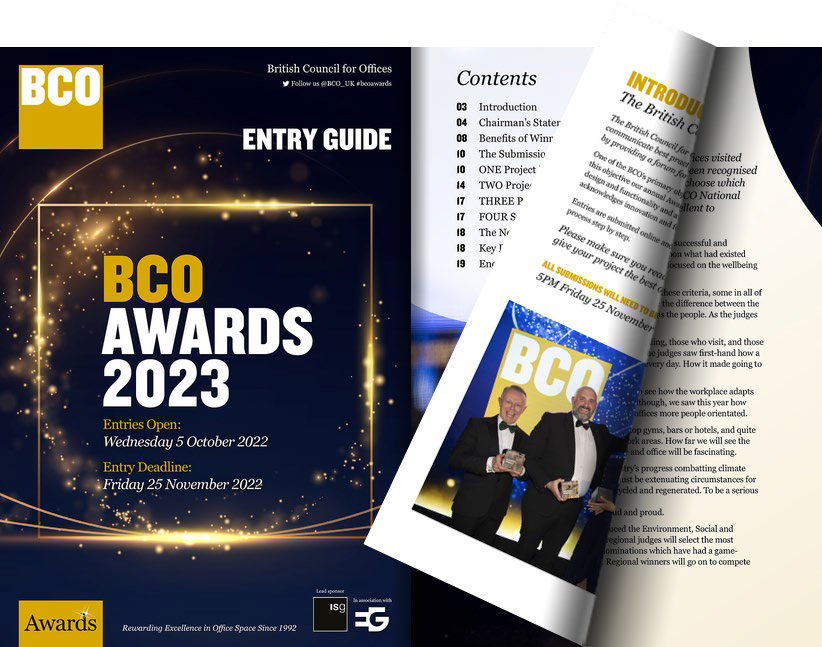
If you haven’t done so already, make sure to download the 2023 Entry Guide and register for our awards competition at www.bcoawards.co.uk. You can save and return to your entry at any point before submitting.
Closing deadline for entries is Friday 25 November 2022 @5pm.
With thanks to our Platinum Sponsor and Media Partner for the BCO Awards 2023

Questions
If you have any questions about the BCO Awards or if you need help with your entry, please email Clare Hollick at Createvents clare@createvents.co.uk or call 01183 340085.
By:
Mike Burton, BCO National Awards Judging Chair 2023

It’s not easy to win a BCO Award: to demonstrate why your project is excellent, your submission requires effort, precision, time, teamwork, and skill – as was required to deliver your development.
And it’s that demanding process that ensures that only special projects even apply, only extra special projects get nominated, and only excellent projects win an Award. So, it really is an outstanding achievement to get hold of one of the coveted BCO golden bricks. It’s so much more than a brilliant night out with great company.
The BCO exists to research, develop, and communicate best practice in all aspects of the office sector. We define excellence in office space, and BCO Award winners are the real-world examples of that. An Award is a celebration of outstanding achievement, that every team member can be proud of and boast about. It provides a focus for others to study, appreciate, and aspire to in their own projects and workplaces.
Winning a BCO Award spreads the word regionally, nationally, and globally. Winning projects are written about in the business, local and national media and we run tours for the winners so visitors can admire and learn from what they see.
Just like the entrants, the BCO Awards, the categories, and the criteria used to determine a winner evolves to reflect what’s happening in the industry and the wider world. When the BCO Awards started in 1992 winners were those that displayed excellence across the board. In 2000 and 2001 the distinct categories we use today were created and the following year Regional Awards began. Three more Awards were added up to 2011 – Presidents, Innovation, and Test of Time. And in 2023 we have added the Environment, Social and Governance (ESG) Award.
That this is the first new category for 12 years highlights the significance of this new Award and our recognition of the challenge that confronts us. The property industry is at the forefront of tackling the climate emergency and our provision of healthier sustainable workplaces is critical for the planet’s future.
The Environment, Social and Governance (ESG) Award
The ESG award will go to a project which has had a game changing influence on the environment. It will recognise social value and the true impact a building has on its users and surroundings. We will examine the role of governance and creditability; we want to find out how energy and water usage has been significantly reduced; and we will celebrate sustainability.
The ESG Regional Award winners will be chosen by the regional judges from the other categories and will go on to compete for the National Award. The judges will be looking at the hard facts. Projects will be assessed and scored on the actual achievements and the proof that they are making a difference. There won’t be any greenwashing – an ESG winner will have made a tangible step to tackling the climate emergency.
The judges will require evidence of the results of your sustainable measures. These include:
Quantifying and costing your submission
Key criterion for the new ESG Award will be the detail and information submitted, letting us know that the money has been spent wisely and that resources haven’t been squandered. And this will be the case for all the Awards, the judges want to see value for money – it’s no good tackling the climate emergency and ignoring the financial crisis.
Across the board, Award submissions will need to give proof to the judges that the money has been used to good effect. We won’t let anybody else know the detail, but a lack of accurate costings will make it virtually impossible to win a BCO Award. As such your best bet is to get this information put together by a professional cost consultant.
Make sure your consultants let us know everything asked for. It should be broken down as illustrated for clear and easy understanding and analysis. Do not skimp on the detail; make sure you explain fully:
One of the key components for a value for money is the longevity and adaptability of the building. We want to know why your project will still be standing-proud in a century. How will it withstand the weather, market demands, technological improvements, and user preferences.
The judges will need details of the building facilities, quality, durability, and maintenance. We will examine building connectivity and intelligence. We will want to see evidence that your project meets the demands placed upon it today and in the future.
We want detail of:
Into 2023

No one thinks compiling this information will be easy and you will need to start early to collect and measure the data. Regardless of the outcome there’s no doubt that the record you build from your submission will be invaluable for you in your other projects. It will be an immense aid to the help the ongoing occupation of the building and its evolution.
But above all, do it right and successfully get across how your project is actually excellent, and on October 3rd, 2023, you might be up on the stage of the Grosvenor grasping a Golden Brick – an Award that is earned not won.

TIME TO START YOUR ENTRY!
Entering the 2023 BCO Awards is easy: simply download the 2023 Entry Guide and register for our awards competition at www.bcoawards.co.uk. Don’t worry if you don’t have all of the project information available at this stage, you can save and return to your entry at any point before submitting.
Entries are submitted online in four steps:
1. Enter project details
2. Answer the ‘Judges Questions’
3. Upload 10 images
4. Pay entry fee and submit
Please make sure to read the section with the Judges’ Questions carefully, as some questions have changed.
Closing deadline for entries is Friday 25 November 2022 @5pm.
Key Dates
2022
25 November: Closing date for entries
1 December: Regional table sales open
2023
January – February: Regional Judging
25 April: London Awards Lunch, London
27 April: Northern Awards Dinner, Manchester
12 May: Scottish Awards Lunch, Glasgow
16 May: South of England & South Wales Award Dinner, Cardiff
19 May: Midlands & Central England Awards Lunch, Birmingham
1 June: National table sales open
June-July: National Judging
3 October: National Awards Dinner, London
With thanks to our Platinum Sponsor and Media Partner for the BCO Awards 2023

Questions
If you have any questions about the BCO Awards or if you need help with your entry, please email Clare Hollick at Createvents clare@createvents.co.uk or call 01183 340085.

Earlier this year, we challenged our NextGen members to put forward their boldest, most innovative and most creative ideas for the future workspace. Centring their focus on the requirements of the modern office, we asked for the most revolutionary ideas yet.
We received brilliant submissions from all who entered; the judging panel were incredibly impressed with the quality and the bold and creative ideas each participant had, and it was difficult for judges to pick out just six finalists.
Over the course of the last few months, our six finalists undertook state-of-the-art public speaking training from Ginger Leadership Communications. Each delivered a full 10-minute TED-style talk to a live audience on Thursday 29 September, flexing their newfound skills and sharing their thought-provoking ideas with the wider industry at Storey Club on Liverpool Street.

The group have been supporting each other throughout the public speaking programme, and will have been on quite the journey together. To avoid pitching them against each other, there was no overall winner — this was an evening to celebrate the achievements of our NextGen community.


Where do you get your best ideas?
Event sponsors: Franchi, British Land, Storey, Multiplex, Parkeray, Gensler, Edge GB, Core 5 and Opera.
Follow the BCO’s NextGen and stay up to date via social media and by subscribing to e-newsletters. E-mail mail@bco.org.uk
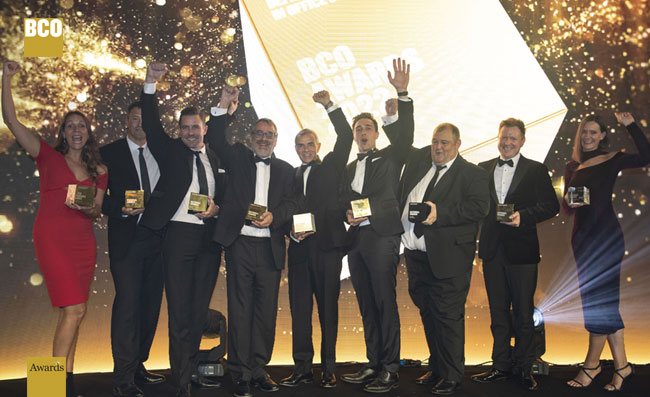
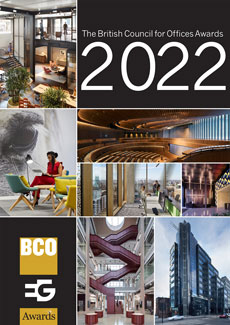
Congratulations to all of our BCO National Awards Winners 2022!
Last night’s Awards dinner at the Grosvenor House in London attracted over 1,200 key players from the industry to celebrate the best-in-class buildings and the talented project teams that have made them happen.
Find out who’s picked up the top prizes of this year’s competition and download your copy of the BCO Awards Supplement.
Are you one of next year’s Awards winners?
Only one way to find out! Entries for the 2023 BCO Awards are now open.
Download the Entry Guide today and start preparing your entry. Make sure you read the Entry Guide carefully as some of the Judges’ Questions have changed.
The closing Deadline for Entries is Friday 25 November 2022.

With Thanks to our National Awards Sponsors
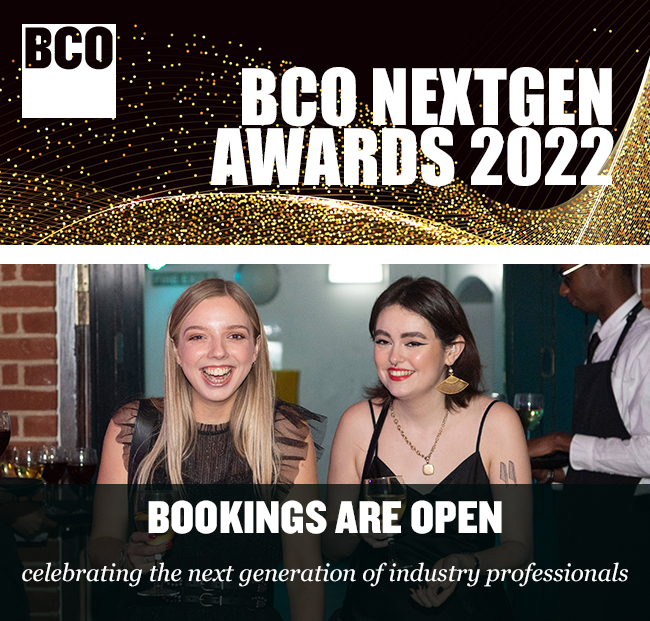
BCO NEXTGEN AWARDS | 23 NOVEMBER 2022
We are delighted to invite you to attend the 2022 NextGen Awards ceremony on Wednesday 23 November. To mark this special event in the BCO’s calendar, and to celebrate the great work of the office industry’s young professionals, we have secured a new and exciting venue: The Bloomsbury Big Top.
The evening will once again comprise of sparkling reception, a sit-down 3-course dinner, the awards presentation (with our must-see host to be announced very soon!), and live music from The Kitts, the ultimate party band.
Both BCO members and non-members are welcome to celebrate with us. Bookings are now open and tickets are available on a first-come, first-served basis, so follow the link below to confirm your place at BCO NextGen’s biggest event of the year!

21 September, Guildhall, London
Last week, members and guests got together at the 2022 President’s Lunch at the Guildhall in London.
In his speech, BCO President Mark Kowal said: “The office of the future will undoubtedly be different – it will continue to evolve, embracing hybrid working, social consciousness, healthy living and environmental responsiveness – and we should be instrumental in this change. The office investment and leasing markets witnessed a robust bounce-back after the pandemic with the UK as the strongest performer in Europe during the 12 months, leading up to the second quarter of this year. More companies across the UK were expanding rather than contracting.”
Optimistic that the BCO community is well positioned to bounce back and stand ready to lead the response to recovery, Mark reminded us: “The theme at this year’s sell-out BCO Conference in Manchester was ‘our time is now’. This is applicable to many aspects of the office: – it is time to change how we work to create a healthier environment and a healthier way of life; it is time for the office sector to play its part in the climate agenda and strive for Net Zero Carbon; it is time for landlords, developers and investors to work more closely with occupiers to achieve all these goals; and it is also time for the BCO to be more bold and be seen to lead and guide our members in pursuit of delivering on these aspirations.”
Financial Times Economics Editor Chris Giles was typically insightful about our economic prospects. While we are almost certainly going to go into recession, however, compared to previous years we understand it more and can manage it. Expect challenges over the Winter, but our cities and their offices have proved resilient time and time again.
Chris concluded that “The recession we are likely to have need not be deep. It may not be very long. And I expect that the Western Economy will get through this.”
Until next time, thank you to everyone who attended. Look out for more photos from the President’s Lunch on Flickr (coming soon).
Follow Mark Kowal, Partner @ Sheppard Robson on LinkedIn.
.png)

By Kat Adair, Associate, Ridge & Partners LLP, BCO NextGen London
Placing employee wellbeing at the heart of ESG agendas is becoming a necessity for companies big or small. And it shouldn’t be a difficult decision to make when considering that the benefits of doing so far outweigh the costs – not only for employees but for companies as well.
The commercial benefits of investing in wellbeing and healthy buildings are increasingly recognised, especially by those companies in the middle to top end of the office market. It’s become clear to them that being proactive about employee wellbeing can help to avoid future costly redesigns, reduce operational costs, and increase productivity and talent retention. In this sense, the benefits of investing in employee wellbeing are becoming much more quantifiable and as such more attractive for decision makers in most sectors.
Now for those with restricted budgets, who are perhaps thinking ‘this is all well and good, but how much is this going to cost us?’. Well, ‘not as much as you might think’ is the simple answer. There are a lot of misconceptions out there about workplace wellbeing, and more generally ESG, being complex and expensive. Although this can be true for those large-scale projects, there are many simple and cost-effective changes that can make a huge difference.
It’s important to remember that not all organisations have the same budget, and in order for wellbeing to become commonplace in our ESG agenda, it must be inclusive.
In my view, a lot of the positive changes we’ve seen in modern workplaces already contribute to employee wellbeing and ESG agendas, even if they are not labelled as such. In a recent research paper on Designing and Managing Buildings for Health and Wellbeing, experts from the British Council for Offices pointed out that ‘small’ changes such as improving office air quality, lighting, acoustics and biophilia are all impactful initiatives.
A healthy building can also be achieved through easy steps such as having well-thought-out FM policies. For example, another recent report from the BCO, on improved ventilation systems in offices post-COVID, suggested that allowing employees to open windows is a more economical and sustainable way to provide them with fresh air than investing in costly ventilation and air monitoring systems. Similarly, well-planned HR strategies around flexible working solutions can have an important impact on employee wellbeing, while only requiring minimal changes around the office.
Of course, for the more complex policies and processes and more drastic changes to your office space, it does appear that having Sustainability or CSR directors leading on large-scale wellbeing programmes is still the most promising path to success. However, this might not be the right approach for all businesses, depending on where they are on their ESG journey.
Leading with the implementation of lower cost facilities management and policy initiatives can reduce capital expenditure, whilst still providing good outcomes for building users, which is a great start.


Cian Scanlon, Associate Architect at PDP London Architects, puts forth his idea for the future workplace in the form of ‘The Disconnected Office’. His experience in the architecture sector is on a global scale, encompassing Amsterdam, Hong Kong and Dublin to name a few. In 2018, he was shortlisted for the RIBAJ’s Rising Stars Award. Cian’s vision proposes a workplace that values physical interaction over digital connection and advocates for decreasing the pace of digital communication as a means to increase productivity, satisfaction and wellbeing.
The Disconnected Office
In the hybrid working age, digital ‘noise’ has become inescapable. The Disconnected Office offers an alternative — a digitally disconnected network of people brought together in a tailor-made physical environment. With hybrid working on the rise, the Disconnected Office provides a fundamentally different experience to working remotely encouraging staff to return to the workplace.
In 1930 John Maynard Keynes predicted that technological advances would enable us to work a 15-hour week. Unfortunately, that’s not the case for most of us. At some point technology outran our ability to absorb it into our working patterns in a productive and healthy way. We spend an increasing amount of time clearing an increasing number of emails and notifications. We commute to the office to connect with colleagues working remotely. The immediacy demanded by apps for digital connection leave us little time for reflection, arguably impede our effective thinking, and sustained over long periods may negatively affect our mental health. The Disconnected Office aims to address these shortcomings by creating dedicated areas where staff can connect digitally, as an exception rather than the rule. This reduces invasive technological stimuli so staff can focus, minimise reactive work and reduce anxiety.
The Disconnected Office is ‘pro-technology’. At the core of the idea is the selective and controlled use of technology to maximise productivity while optimising employee experience and wellbeing.
Part of removing the distraction of the digital network is to place the emphasis back on real-life connection. The lack of distraction will encourage and inspire staff to engage with each other and the wider community.
Written By Eilidh Tuckett.
Attend the BCO Ideas Project Final Showcase Evening on 29 September where the selected finalists will be sharing their 10-minute TED Talk style pitches. Visit bco.org.uk to book.


In his idea for ‘The People’s Workplace’ Andreas Leonidou, Consultant Cost Manager at Turner & Townsend, brings his range of experience in both the residential and commercial market sectors to the table. As a quantity surveyor, Andreas has worked alongside several major high street retail brands and organisations, as well as corporate business-to-business clients and residential developers. This first hand experience means he is well positioned to imagine a better future for the workplace.
The People’s Workplace
Magic Johnson, former owner of Starbucks and Burger King, once said: ’if the community is happy, then they support your business, and if your business is doing well, then you can give back even more to the community.’ This concept underpins the idea for The People’s Workplace — a genuinely hybridised working environment which brings community together in a productive, collaborative space.
Positive social impact is the driving force behind The People’s Workplace. It aims to address the inequalities between communities, which are based on the strength of community infrastructures, from design inception.
The current amount of underutilised UK office space, when applying the BCO’s recommendation of 89-108 square feet of space per person, would allow for between 530,000 – 650,000 people associated with local communities and educational organisations to be supported. By evolving these underutilised spaces into hybrid commercial community workplaces, we can drive positive change, bringing communities together. Crucially, this also avoids unnecessary construction, which is a step in the right direction towards addressing the climate emergency.
The People’s Workplace would incorporate spaces for both commercial businesses and local community and learning organisations, such as lecture theatres, seminar classrooms, exhibition halls and local charities. This closer working proximity would create a more fluid exchange between sectors, making it easier for organisations to achieve genuinely positive social impact.
Local charities could set up opportunities for their neighbouring employers to support events or fundraising activities, which would in turn assist the surrounding businesses in achieving their social impact goals. From an education standpoint, professionals from neighbouring businesses could offer relevant career advice, lectures and workshops.
Business professionals would be able to engage with charities and educational organisations, which would in turn create a strong sense of support from the commercial sector. New Technologies such as virtual collaboration tools could also be incorporated, further solidifying the sense of community.
Instead of a purely commercial-focused workspace, this widened working environment would break down the barriers between business, charity and education — creating genuine community. The People’s Workspace aims to transform the future of the workplace, for the benefit of everyone.
Written By Eilidh Tuckett.
Attend the BCO Ideas Project Final Showcase Evening on 29 September where the selected finalists will be sharing their 10-minute TED Talk style pitches. Visit bco.org.uk to book.

 August 28, 2026
  By BCO Media