Media Hub Archives - Page 2 of 7 - BCO - British Council for Offices Media Hub Archives - Page 2 of 7 - BCO - British Council for Offices

Squaredot business design development executive and national chair of the BCO’s mentoring programme Joe Huddleston is passionate about a lot of things, but none more so than his home town of Birmingham and the power of mentoring.

Huddleston has been chair of the mentoring programme, which is now in its sixth year, since 2024, and is on a mission to ensure that everyone with the BCO NextGen cohort – and those not yet signed up –  know about the wonderful opportunity on offer.

The opportunity is simple. If you are one of the many hundreds of BCO members that are under the age of 35, you are entitled to free mentoring from one of the 50 mentors within the organisation.

“It’s a fabulous opportunity for the younger generations to get mentored and to join the built environment community and really start contributing to all the good that we’re doing within the industry,” says Huddleston.

For Huddleston, the mentoring programme is one of the BCO’s best kept secrets – although he’s keen to change that. He wants everyone to know that the opportunity is on offer and to showcase the value that mentoring can provide – for all of us.

“We see that the benefit of the mentor programme is for both mentor and mentee,” he says. “There’s a lot that the mentor also gets out of this process. Through trying to articulate how to solve a problem from a mentor’s perspective, they also get insight into how they deliver their own work and articulate themselves and I think it can be quite exposing sometimes.

“We’re always learning and we’re always trying to develop and I think that through trying to articulate the best way to tackle a problem, you also start to tackle some of your own demons.”

Mentoring and being mentored has been a big part of Huddleston’s own career. He’s an asker of questions and likens this to being continually mentored.

“I’ve continually asked questions throughout my career and while I’ve not had a specific mentor, I’ve sidled up to people who I think can help and support me,” says Huddleston. “Typically I’ve sought mentorship from people who have continually pushed and challenged me. Those are the people that I feel I’ll get the most from and the ones that will try and get the most out of me.”

Huddleston’s passion for developing talent in our industry through fostering valuable mentoring relationships, is matched by his love of Birmingham and workplace design.

Born, bred and educated in Birmingham, Huddleston has worked for Aedas, Overbury, Gensler and Modus Workspace before his current role at SquareDot.

“I’m very proud of Birmingham and how it keeps reinventing itself,” says Huddleston. “I think the city really has transformed. I’m proud to see that it has reinvented itself over time and that the central hub has been carefully curated with a wonderful amount of amenity that’s really drawing people to it.”

Listen in to Workspace Unwired: Why Mentoring Matters to hear more from Huddleston on Brum’s powers of reinvention and my mentoring could be your secret weapon to success.


Tune in to a new episode of the BCO’s Workspace Unwired every fortnight. Available on all  good podcast players including AppleSpotifyAmazon and Podbean.

At a recent BCO London Committee seminar hosted at Storey at 100 Liverpool Street, industry leaders gathered to dissect one of the most dynamic themes in commercial real estate: flexibility in office space.

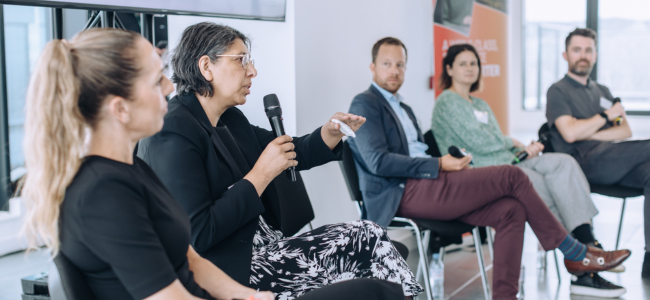
Moderated by BCO chief executive Samantha McClary, the panel featured experts from across the sector—Will Kinnear, director at HEWN, Becky Gardiner, head of Storey and managed workspaces at British Land, Christy Bowen, head of London offices and flex space – value at risk advisory at JLL, and Craig Owen, director of property and workspace at Legal & General—who explored the evolving landscape of flexible workspaces and the implications for occupiers, landlords, and investors.

Unpacking the f-word

With only a handful of attendees confident in defining the difference between flex, co-working, and managed space, Kinnear provided a clear breakdown of the terminology and structure that sit beneath the flex umbrella:

  • Cat A space: The traditional landlord offering – empty, fitted only to a basic standard, ready for tenant customisation.
  • Cat A+ or “product” space: A step up, featuring desks, tables, and chairs – ready for immediate occupation but without ongoing management.
  • Managed space: Fully fitted space, often at floor or building level, with an additional layer of management provided on behalf of the occupier or landlord.
  • Serviced or flex space: The most comprehensive model, encompassing everything from co-working and hot desking to private offices and amenity-rich environments, all operated under a flexible, service-led model.

Kinnear highlighted how flex had evolved into a spectrum of workspace options – from traditional leases to fully managed environments – each catering to different occupier needs and investment strategies.

However, while understanding the terminology is clearly important, end user Owen said the most important thing for an occupier was how well the space and the service was managed once you’re there.

What occupiers want

British Land’s Gardiner emphasised that successful flex models started with a clear grasp of what businesses actually want from their space. She explained how flexibility was not a single product but a spectrum of solutions, and that property owners must align operational delivery and amenity with occupiers’ expectations to create environments that truly add value for both sides.

Kinnear argued that amenity alone was no longer enough and that it was service that was now the differentiator. He highlighted the growing importance of hospitality-style operations and event-led programming, noting that while this evolution presented challenges for a traditionally static property sector, it also created opportunities for operators that can deliver meaningful, service-led experiences.

Gardiner agreed, saying that delivering amenities alone wasn’t enough. She said that operational excellence underpinned retention and renewal, and that occupiers were largely willing to pay a premium for that.

She warned, however that there was a ceiling on that price and that if a market emerged were occupiers were unwilling to cover rising service and operational costs, the financial model for fully managed or flex space could face real pressure.

The flex blur

With so many different solutions available for occupiers in the market and service becoming a buzz word across all forms of workspace provision, the panel turned its attention to whether the growing “hotelification” of offices risked diluting the distinct appeal of flex space.

Hewn’s Kinnear suggested that the industry was already moving toward a future where flex would no longer exist as a separate category but would become a standard component of every building – offering a mix of traditional, fitted, managed, and serviced space under one roof. He noted that while major landlords such as British Land and Landsec have successfully brought flex operations in-house, many owners still face challenges in finding the right partnership or operating model.

Gardiner agreed, explaining that British Land’s own portfolio reflected this shift, with occupiers increasingly seeking fully managed, hassle-free solutions – even larger businesses now preferring landlords to handle services traditionally managed in-house.

JLL’s Bowen said the market has already evolved into this spectrum, with what began as a divide between traditional leased and serviced space now merging, with fitted and managed solutions bridging the gap between the two.

From a valuation perspective, Bowen said this merging of traditional, fitted, managed, and serviced space within a single building had made assessing value increasingly complex.

In the past, Cat A space followed a predictable rental pattern, but today, variations in layout, fit-out, and flexibility can create as much as a 50% difference in rental values within the same asset. As landlords layer in more flexible offerings, said Bowen, the risk profile typically increases due to shorter lease terms – but so too does the potential return.

The evolution of how office space is provided is demanding new valuation approaches, said Bowen, as each level of flexibility commands a different balance between risk, yield, and revenue potential.

A flexible future

While the longevity of flex as we know it today was questioned in a market where flexibility is becoming the norm, the panel agreed that what made the sector so compelling was its ability to continually evolve.

Today the market fundamentals for the sector are strong, with occupancy steady at around 95% for leading operators. However, for operators to really deliver sustainable growth, they will have to focus even harder on understanding occupier wants – novelty amenity might turn heads but it won’t deliver loyalty – and will need a much clearer and reliable dataset on supply and demand.

The flex market today is unlikely to be the flex market of tomorrow. It is likely to consolidate, with smaller, less-resourced operators exiting, while those that combine hospitality, community, and operational excellence will flourish.

But ultimately, flex is here to stay. It’s not just a trend, said our panel, it’s an operational philosophy.

Five key takeaways:

  • Flex is a spectrum, not a category: From Cat A to serviced space, flexible workspaces span a range of models tailored to different occupier needs and investment strategies.
  • Service is the new differentiator: Amenities alone no longer suffice—hospitality-style service and operational excellence are now central to occupier satisfaction and retention.
  • Flexibility has been normalised: The boundaries between traditional and flexible space are blurring, with flex increasingly integrated into standard building offerings.
  • Valuation is more complex: As flexibility increases, so does the complexity of assessing value—requiring new approaches to balance risk, yield, and revenue.
  • Flex isn’t a product, it’s a mindset: More than a product, flex represents a philosophy of adaptability, shaping the future of workplace strategy through continual innovation.

With thanks to British Land for kindly sponsoring this event.


In today’s evolving work culture, the conversation around disability inclusion is gaining long-overdue momentum – but more action, education and understanding is needed.

That’s why the BCO NextGen London & South East committee gathered a panel of experts at Arup’s 80 Charlotte Street offices in London to dive deeper into how we need to ensure we are creating workspaces that are inclusive and accessible for all.

The panel, chaired by James Taylor, co-founder of MotionSpot, brought together Frankie Pringle, architect and founder of Studio Pringle, Mei-Yee Man Oram, associate director and global accessibility and inclusion lead at Arup, and Jennie Berry, disabled content creator and educator and business engagement lead at Sociability, who each offered a compelling look at how inclusive design can and must go beyond compliance to create truly equitable workplaces.

One of the most powerful themes to emerge was the need to move beyond regulatory checklists. As Berry pointed out: “I’m not sat outside a building with a protractor measuring ramp gradients. I just need to know if I can get in and have the same experience as everyone else.”

This sentiment was echoed by  Pringle, who emphasised that many buildings still fail to meet even the minimum standards of Part M of the UK Building Regulations.

“Sometimes we don’t even tick the boxes,’ she said, highlighting a widespread lack of awareness and accountability in retrofit projects. She called on the audience to stop using accessibility statements as a get around.

While it is clear that inclusive design is a moral and social responsibility, the panel also stressed its business value.

Accessible workplaces attract and retain diverse talent, foster innovation, and reflect positively on company culture.

Berry shared her own experience of struggling to find employers who provided accessibility information during the recruitment process. “It’s no use going through the whole process only to find I can’t access the interview room,” she said.

This lack of transparency not only deters disabled candidates but also signals a broader cultural gap.

As Taylor noted: “We’re not just talking about ramps and lifts—we’re talking about dignity, autonomy, and belonging.”

The role of technology

Technology is playing a transformative role in inclusive design. From smart sensors that monitor lighting and noise levels to customisable room booking systems, digital tools are enabling more responsive and adaptable environments.

Oram described how Arup uses data to help employees choose workspaces that suit their needs on any given day, whether due to neurodivergence, migraines, or menopause symptoms.

Sociability’s platform, Berry added, empowers users to filter spaces based on specific access needs, reclaiming agency in a world that often tells disabled people where they can and cannot go.

The discussion also shed light on the often-overlooked reality of hidden disabilities. Pringle, who lives with a paralysed vocal cord, described the frustration of not being heard in noisy office environments.

The solution? Choice.

Providing a variety of settings – quiet zones, acoustically treated rooms, and flexible layouts – ensures that everyone, regardless of their needs, can find a space that works for them.

Lived experienced matters

A recurring message was the importance of embedding inclusive design from the earliest stages of a project. Oram emphasised that inclusion should be part of the brief, not an afterthought. This includes considering travel routes, safety, and engagement with end users, especially those with lived experience.

Berry was unequivocal: “It has to be led by lived experience. Not just one disabled person, but a whole host of voices.”

She also encouraged following disabled creators online to build awareness and empathy beyond the workplace. (You can follow Jennie on Instagram at wheelie_good_life).

While there is still so much to be done to create truly accessible and inclusive places, the panel remained largely optimistic.

“We are seeing a shift,” said Berry. “People are realising that inclusive design doesn’t have to be expensive. Sometimes it’s as simple as better signage or clearer communication.’

The message is clear. Inclusive design benefits everyone. And with the right mindset, tools, and leadership, we can build workplaces that truly work for all.

Five key takeaways:

  • Go beyond compliance: Meeting regulations is the bare minimum. True inclusion requires empathy, creativity, and a willingness to challenge the status quo.
  • Design for flexibility: One-size-fits-all doesn’t work. Offer a variety of spaces and settings to accommodate visible and invisible disabilities alike.
  • Engage lived experience: Involve disabled people from the outset. Their insights are invaluable and often highlight issues that compliance alone can’t address.
  • Leverage technology: Use digital tools to enhance accessibility, from wayfinding apps to customisable workspaces. Tech can empower users and reduce the need for disclosure.
  • Make the business case: Inclusion isn’t just the right thing to do—it’s smart business. Diverse teams are more innovative, resilient, and reflective of the world we live in.
With thanks to ARUP for hosting and sponsoring this important discussion.

A total of 31 outstanding individuals and firms have been shortlisted for this year’s BCO NextGen Awards.

The awards, which take place on Thursday 13 November at Skylon in London, will see 10 trophies handed out, including a special one-off award to celebrate a decade of BCO NextGen activities.

After an intense and highly competitive judging process, the BCO can now reveal who will be battling it out to take home the NextGen Rising Star awards in London & the South East, the Midlands and East Anglia, Northern England, North Wales and Northern Ireland, Scotland and in the South West and South Wales, alongside awards for Employer of the Year, Graduate of the Year, the Impact Award and Inspirational Leader of the Year.

This year, to mark the 10th anniversary of the awards, the BCO has also introduced a special one-off category –Outstanding Contribution to BCO NextGen. This award recognises an individual who has demonstrated exceptional commitment to the BCO NextGen community, going above and beyond to foster inclusion and to provide opportunity for the next generation of property professionals.

Judges were particularly impressed this year by the depth of talent, innovation, and leadership shown across the UK’s commercial property sector.

The shortlisted individuals and organisations truly exemplify the values at the heart of BCO NextGen — ambition, impact, and a commitment to shaping the future of the workplace.

Created to recognise and celebrate emerging talent in the workplace sector, from future-focused graduates to employers creating inclusive and dynamic environments, these awards celebrate those who are making a real difference, both within their organisations and in the wider industry.

Congratulations to all who have made the list this year. We look forward to celebrating with you at the 10th anniversary awards dinner next month.

For those who have not yet secured their ticket click here. Or if you would like to find out more about how you can support fresh new talent in our sector, email us at events@bco.org.uk

NextGen Rising Star London & South East

Luke Askwith
architect, senior associate, Gensler
Alexander Buck
head of sustainability, Buckley Gray Yeoman
Kate Hosking
senior architect, Buckley Gray Yeoman
Lauren Lemcke
senior project surveyor, AECOM
Nathan Shelley
associate director, AECOM

NextGen Rising Star Midlands and East Anglia

Allison Au
architect, associate, Gensler
Francesca Ghavami-Milnes
associate interior designer, Howells
Eleanor Penny
head of workplace, Layrd Design

NextGen Rising Star Northern England, North Wales, and Northern Ireland

Nicholas Birchall
associate architect, Hawkins\Brown
Archontia Manolakelli
project architect and senior design researcher, AtkinsRealis

NextGen Rising Star Scotland

Sarah Lawson
architect and associate, MLA
Lucia Savastano
principal sustainability engineer, Cundall, Johnston and Partners
Kieran Smart
mechanical engineer, WSP

NextGen Rising Star South West England and South Wales

Kallum Desai
global scopeX carbon practice lead, AECOM
Georgios Grigoriou
delivery lead, Workman
Josie Young
principal consultant, Hoare Lea

Employer of the Year

AECOM
8build
Hawkins\Brown
Layrd Design

Graduate of the Year

Aleksandar Bajić
part 2 architectural assistant, Gensler
Joshua Knight
part 2 architectural assistant, Make Architects
Harshini Rajagopal
graduate sustainability engineer, Cundall

Impact Award (formerly Diversity & Inclusion Champion of the Year)

Joelyn Elias
graduate project manager, AECOM
Francesca Ghavami-Milnes
associate interior designer, Howells

Inspirational Leader of the Year

Theodor Bratosin
senior sustainbility and building physics engineer, Cundall
Dave Cheshire
sustainability director, AECOM
Will Mayes
ceo & founder, Laryd Design
Rob van Zyl
partner, Cundall

Outstanding Contribution to BCO NextGen

Mike Burton
director, AECOM
Amy Leech
project director, tp bennett

We are pleased to share that our chief executive, Samantha McClary, has been honoured with the Built Environment Award at the newly renamed awards event, previously known as the Property Awards – reflecting the University’s refreshed identity and vision.

The headline Built Environment Award was presented to Sam in recognition of her two decades of impact across the property and workplace sectors. Before joining the BCO, Sam spent 20 years at Estates Gazette, where she served as editor until January.

Since 1987, University of the Built Environment has presented its annual Built Environment Award (formerly the Property Award) to a person or organisation which has made an outstanding contribution to the property industry.

In her acceptance speech, Sam said:

“It’s really humbling to pick up an award that has been given in a former guise to so many phenomenal human beings. The imposter syndrome in me says that I’m just a journalist, just doing a job and trying to nudge this industry along in the right direction, so it’s really wonderful to be recognised for that.” 

Widely regarded as both a champion and challenger within the sector, Sam has been a driving force for diversity, inclusion, sustainability, and innovation – from launching the Future Leaders programme to serving on the advisory board of Black Women in Real Estate. Since taking the helm at the British Council for Offices in May, she has continued to shape the debate during a pivotal moment for the workplace sector.

We are proud to see Sam’s leadership and contribution recognised through this award and extend our congratulations to all nominees and winners who continue to drive excellence across the built environment.

Photos courtesy of The University of The Built Environment.

The 2025 BCO NextGen Ideas Competition, held at Hawkins/Brown’s Clerkenwell studio on Thursday 9 October, saw six finalists take to the stage to present bold, human-centred concepts for the future of the workplace.

Each finalist’s idea was shaped by mentorship, from both a 2024 finalist and a BCO mentor, and refined by public speaking training from Ginger Leadership Communications. The result was a night of compelling presentations that reflected a shared commitment to transforming how we work, live and connect in and around the office.

Throughout the evening, the NextGen finalists issued calls to action for the industry to meet the urgent challenges and exciting possibilities of tomorrow’s workplace.

While this year a single winner was selected –  AECOM’s Lauren Lemcke (pictured), whose concept CarbonLegacy earned her a ticket to next year’s BCO conference – the evening was a celebration of all six ideas and the collaborative spirit that defines the BCO NextGen community.

Workplaces that restore, not just perform

A recurring theme throughout the evening was the transformation of the office from a place of productivity to a destination of wellbeing and experience.

Plug-in Workspitality, a concept from Gensler’s Justin Lau, responded to the flight to quality by arguing that the office should do more. His proposal suggests the introduction of ‘Tetris-like’ modular plug-ins embedded throughout office cores, to improve a building’s amenity offer. This ranged from breakout spaces for group work to spaces for nourishment, exercise, healthcare and pop-up cultural events. These different zones are designed to respond to an employee’s changing needs throughout the day.

Also from Gensler, Allison Au’s Cinetecture takes a different approach to human-centred design by looking at the cinematic quality of emotionally engaging environments. A self-described ‘imagineer’, Au drew on Millennial and Gen-Z trends to create Instagrammable spaces, asking the audience to imagine workplaces that feel like boutique hotels or film sets – spaces that inspire and connect. She highlighted the rise of the experience economy, with 2.5bn social users forming new connections with brands and companies, and called for the BCO to incorporate function and experience into its office guidelines, including opportunities for reviews of fit-out across office spaces.

Together, these ideas reflect a growing desire to treat employees as guests rather than workers and find ways to embody the sense of value, care and inspiration needed to achieve this.

From sustainability to social value

Environmental responsibility was another powerful thread, with finalists proposing systems that embed sustainability into the very infrastructure of the workplace.

From Spec Commercial, Liam Jeanes challenged the audience to imagine not just the future of the office but the future of society, asking: “How would you survive in London if the wheels fell off?”

His concept, OFF GRID, extrapolates existing models, from GSK’s vertical farm to blue roofs, to position the office as infrastructure; reframing our building sites of agricultural production and sources of essential resources.

AECOM’s Lemcke introduced CarbonLegacy, a platform that converts embodied carbon savings from fit-outs into community investments. Her presentation shed light on the uncomfortable truth of office fit-outs.

“Over a 60-year period, more emissions are produced by the carpets and coffee tables in offices than by the concrete structure of the buildings,” she said.

Designed to slot into occupiers’ wider corporate social responsibility policies, CarbonLegacy involves converting carbon emissions into “legacy credits” that companies can use to track their carbon reductions and reinvest them into local projects.

Her presentation encouraged the BCO to adopt CarbonLegacy as part of its fit-out guide, bridging the gap between environmental responsibility and social value.

Kinga Zadora, representing ODGroup, took to the stage with REGEN Performance Clauses, a concept that turns service charges –  “the dullest bill in real estate” –  into a tool for driving measurable social and environmental value.

Her model rests on a points-based system, allowing tenants to earn rent reductions by meeting agreed sustainability and community engagement targets. With the clauses, frameworks and data already in place, Zadora proposed smart service charges to match the smart meters and tech in offices, concluding that “service charges just got interesting.”

Designing for life beyond the office

Alongside ideas focused on environmental impact and community value, the presentations also turned attention to the personal realities of working life, highlighting how workplace design can better support caregiving and inclusion.

Representing Whitecroft Lighting, Sophie Woodland delivered one of the evening’s most personal presentations.

Her concept, Making Family Work, reimagines the workplace as a space where parenting and professional life are not at odds, but integrated by design.

Her concept addressed the invisible barriers to women returning to work, noting that 34% of workers don’t return to the same job after parental leave, as she put it: “That’s 34% of experience, talent and employable people quietly leaving.”

Drawing on her own experience as a working mother, she proposed a model that includes co-working zones for parents and children, onsite early years learning hubs with flexible enrolment and sustainability-focused initiatives such as rooftop gardens and forest schools.

“What if we designed workplaces that actually work for families?” she asked. “Instead of hiding children away, what if we bring them in?”

A key ingredient in the success of all the ideas presented was the BCO’s mentorship programme.

Each finalist received guidance from both a seasoned BCO mentor and a previous finalist. This dual mentorship model not only elevated the quality of the presentations but also reinforced the idea that innovation is born out of community.

Across the evening, the finalists all offered visions for workplaces that are more responsive, inclusive and socially engaged. Their ideas challenge the notion of the office as a purely functional space, instead positioning it as a place where people can connect, contribute and thrive together.

BCO chief executive Samantha McClary, closed the night fittingly by reassuring the audience that “we can sleep easy tonight knowing that the future is in good hands”.

“The NextGen is a future generation that cares, that sees the problems we’re facing and isn’t afraid to find solutions,” she said.”

The BCO NextGen Ideas Competition 2025 is supported by Hawkins/Brown, Artus Air, Derwent London, Multiplex, Cushman & Wakefield and Parkeray.

An office designed entirely around circular economy principles, a 3,300m² living wall and a former infirmary transformed into a modern office and events space, were just three of the amazing office innovations highlighted at the BCO’s National Awards event.

The awards, widely recognized across the built environment for celebrating the very best in office design, development and operation, took place at the JW Marriott Grosvenor House hotel on London’s Park Lane on 7 October.

The winners, announced in front of an audience of more than 1,200 senior figures from across the office sector, showcase what it takes to create a successful office in today’s environment and how those leading the way are revitalising cities, cutting carbon and setting new benchmarks for best-in-class.

Unusual HQ in Northamptonshire, home of lighting and stage engineering solutions provider Unusual Rigging, took home two awards on the night – one for Corporate Workplace and the Best of the Best gong.

The project was given the awards for not only achieving the very highest energy performance rating of EPC A+ and being built entirely on circular economy principles, but for exemplifying how modern offices have evolved to become beacons of sustainability best practice.

A key highlight for judges was how this innovative building could be disassembled and reused at the end of its life, massively reducing its carbon footprint.

The Edinburgh Futures Institute, a former Victorian infirmary transformed into a modern office and events space, collected the BCO’s Innovation award. The restored 20,000m² space includes state-of-the-art teaching facilities, co-working space, business incubator space, plus exhibition and event spaces.

The judges were  particularly impressed by the excavation under the main concourse to form a new auditorium, the innovative construction techniques used to restore and enhance the building, and the commitment of the University of Edinburgh to turning Scotland’s oldest voluntary hospital into a hub for future thinking.

Other winners on the night included One Station Hill in Reading, which picked up the award for Commercial Workspace, Capital Group’s HQ at 1 Paddington Square, PC, which won Fit Out of Workplace and Eden in Salford’s New Bailey development site, which was crowned winner of the ESG award. Eden is a LETI Pioneer project and is the UK’s first commercial office to achieve a 5.5-star NABERS UK “Design Reviewed” rating.

This year’s event also handed out its first awards for customer experience, a new category focused on how well the UK’s offices are serving the people that occupy them.

GPE’s Woolyard development in London Bridge, SE1, won the Customer Experience – Commercial Landlord – award, with judges labelling the service as “game-changing”, with building managers understanding client needs, providing a genuine sense of care and enabling customers to succeed.

Natwest raised the Customer Experiencer – Corporate Occupier – award aloft for its offices at 250 Bishopsgate, EC2. The integration of technology with human-centred service throughout the building, plus the bank’s commitment to capturing the voices of 9,000 colleagues through various surveys to directly inform customer strategy, were standout actions for the BCO’s judges.

Mike Burton, chair of National Awards judging panel, said: “This year’s judging process revealed a notable shift in how we define excellence in the workplace. The 2025 winners show how the UK’s office sector is leading the way in creating spaces that are not just high-performing and sustainable, but deeply human. The winning projects prove that offices can be catalysts for wellbeing, creativity and urban renewal. “

Make Architects founder Ken Shuttleworth was handed the prestigious President’s Award at the event. He was honoured by BCO president Helen Hare for his outstanding contribution to the real estate industry.

“Ken’s philosophy is not just about the architecture of an individual standalone building,” said Hare. “It is about creating a place – one that must have a heart. Ken has genuinely made a difference to our industry. His fearlessness in breaking down architectural boundaries, dedication to bringing through the next generation of architects, while supporting other aspects of the office sector, is why he is the perfect recipient of this year’s BCO President’s Award.”

Shuttleworth is recognised as one of the world’s leading architects and continues to deliver a portfolio of iconic, innovative and sustainable buildings.

Over the course of his 50-year career he has worked on some of the most groundbreaking architectural landmarks in the world, from HSBC in Hong Kong to London’s Canary Wharf. He was one of the first to develop a 100% employee-owned architectural business and is committed to diversity, inclusion and recognising the importance of people.

BCO chief executive Samantha McClary added: “The BCO Awards are a celebration of bold thinking and brilliant execution. What stands out this year is the sheer diversity of innovation taking place, from circular economy construction and biophilic design to inclusive, neurodiverse environments and flexible leasing models. These workplaces – and the people who creature and curate them – reflect a sector that’s listening, learning and leading the way in meeting future challenges and opportunities head-on. The BCO is proud to champion this evolution and the people driving it”

The full list of winners from this year’s BCO National Awards:

  • Best of the Best – Unusual HQ, Northampton  
  • Corporate Workplace – Unusual HQ, Northampton  
  • Commercial Workplace – One Station Hill, Reading 
  • Fit Out of Workplace – Capital Group, 1 Paddington Square, London 
  • Projects up to 2,500m² – Englefield Estate Yard, Reading
  • Refurbished/Recycled Workplace – Norton Folgate, London
  • Innovation – The Edinburgh Futures Institute, Edinburgh
  • ESG – Eden, Salford 
  • Test of Time – BBC Wales, Cardiff
  • Customer Experience, Commercial Landlord – Woolyard, London
  • Customer Experience, Corporate Occupier – 250 Bishopsgate, London
  • President’s Award – Ken Shuttleworth, Make Architects

Seven projects were highly commended at this year’s awards. They include Dojo Bristol for Fit Out of Workplace, the Living Lab in London for Projects of up to 2,500m², Foundation in Altrincham for Refurbished/Recycled Workplace, Oldham Spindles for Innovation, 11 Belgrave in London for ESG and Here East in Stratford and Ovo Energy’s HQ at Cadworks in Glasgow for the BCO’s new Customer Experience awards. They were highlighted in the commercial landord and corporate occupier categories respectively.

Huge thanks to this year’s sponsors of the BCO awards, including platinum sponsor AET Flexible Space, Gold sponsors AECOM, Glamox, Morgan Lovell, Troup, Bywaters + Anders and silver sponsors Cundall, GPF Lewis and Quantem are silver sponsors.

Estates Gazette is media partner to the awards and those interested diving deeper into the award winners can read our awards supplement with the next edition of the magazine or browse the digital version here.

Entries for 2026 awards are now officially open. Find out how to make sure your project makes it on to the BCO’s regional and national shortlist by downloading the 2026 Entry Guide here

Cath Macpherson, director at Hoare Lea, has been appointed as the new chair of the BCO’s South West committee. She takes over the position from John Wright, director at Stride Treglown, who was appointed junior vice president of the BCO in July this year.

Wright will remain as a member of the committee.

Macpherson first became involved with the BCO in 2017 when she became a judge for the body’s South awards. She has some 15 years of experience working in the office and workplace sector and is passionate about making sure our offices truly work for the people who use them.

“I’m really pleased to be taking on the role of chair for the BCO’s South West committee,” said Macpherson. “As chair, I want to bring more of an occupier’s perspective to the committee, which is why I’ve already invited a couple of new members from that side of the market.”

She added: “We’ll be bringing forward more events focused on occupiers and continuing to provide members with great building tours across the region. I’m also keen to help demystify accreditations for our members so they can better understand what they mean and how they add value.”

Macpherson said she was looking forward to working with the committee to help shape great workplaces across the South West.

The South West committee currently comprises 17 BCO members, with four recent new additions, including Isabelle Davies from Legal & General, Danielle Kirk from LSH, Sarah Mitchell from Overbury and Toni Riddiford from Stride Treglown.

The full committee is as follows:

  • Catherine Macpherson, Hoare Lea (chair)
  • Charlotte Acreman, CBRE
  • Harry Allen, Savills
  • Gary Carver, Savills
  • Isabelle Davies, Legal & General
  • Henry Harrison, Mapletree
  • Matthew Heaman, Hoare Lea
  • Andrew Heath, CSquared
  • Danielle Kirk, LSH
  • Sarah Mitchell, Overbury
  • Mark Nevill, Ramboll
  • Toni Riddiford, Stride Treglown
  • Mark Rogers, Turner & Townsend
  • Emma Wan, AWW
  • Paul Webber, Arup
  • Ian Wills, JLL
  • John Wright, Stride Treglown

To find out more about the BCO South West and to keep up to date with all its events and activities follow the committee on LinkedIn

Betsy Brady, Knight Frank

BCO NextGen member and Knight Frank development surveyor Betsy Brady has always loved buildings and development. That passion comes across loud and clear in the BCO’s Workspace Unwired podcast, in which she proposes that offices are no longer just places of work—they are spaces for connection, purpose, and human flourishing.

At the heart of Brady’s philosophy is the idea that the office must serve a human-centric purpose. She challenges superficial post-pandemic design trends – remember the slides, basketball courts and ball pools? – and instead advocates for deeper thinking about what human beings really need to be productive, happy and fulfilled.

For her a great office, a functional office where people choose to go, is one that goes beyond the aesthetic and thinks about how space works as a reflection of a company’s ethos and how it enables the human beings that inhabit it to perform to the best of their ability.

A great workspace is one that enables businesses to get their best out their workforce.

“There’s real work going into how can we make spaces where you can nurture your young talent, bring returners into work and feel valued,” says Brady. “As we move into a very human-centric workplace, the human element isn’t just about whether people want to be in the office or do they want to be at home, it is about things like how the psychoacoustics affect someone who’s 20, who’s 30, who’s 40.”

With the workforce now spanning more generations than ever before, creating spaces that are adaptable and flexible for different workstyles is vital, says Brady.

Ultimately, we have to create offices where people want to be.

“The office has been around for years and it will continue to be around for years,” says Brady. “But we now have an opportunity to make it something where people leave being happy that they went.”

Listen in to Workspace Unwired: Beyond the Aesthetic to hear more of Brady’s optimism, why workspace is the best place to build a career and why our offices can—and should—be a source of joy and purpose.


Tune in to a new episode of the BCO’s Workspace Unwired every fortnight. Available on all  good podcast players including Apple, Spotify, Amazon and Podbean.

Last month, Cundall’s management board met in Birmingham. I welcomed colleagues from across the world and, afterwards, I took them on a walking tour of the city.

We started in St Paul’s Square, the green oasis that once hosted our own offices, before moving on to landmarks we’ve been part of delivering, including Three Snowhill, a striking 17-storey Grade A office building in the city’s business district.

A short walk down Colmore Row brought us to Paradise. Paradise? In Birmingham? For those who haven’t visited in a while, the surprise is understandable. Yet this £1.2bn development is transforming the civic heart of the city, blending heritage with modernity and creating over 1m sq ft of contemporary office space. It’s the kind of bold vision that captures what Birmingham is becoming.

More than a second city

Like so many in the local business community, I’m not originally from the West Midlands, but more than 20 years on, I now count myself among Birmingham’s most passionate advocates.

Sure, the city is not without its challenges. A cash-strapped council and ongoing bin strikes have led to unwanted headlines and fuelled longstanding jokes. A second rate Second City some might say.

But make no mistake about it, Birmingham is on the rise.

A bold vision

With the Mayor’s Growth Plan now on the table in Westminster, a new Mayoral Development Corporation announced and the government’s landmark Regional Investment Summit coming to Birmingham, the region’s growth is in full motion.

Underpinned by a vision of raising living standards, reducing poverty and progressing toward net zero, the West Midlands Growth Plan sets out goals including:

  •  an economy £17.4bn bigger by 2035
  •  tens of thousands of new jobs
  •  thousands of homes each year

The MDC is designed to accelerate regeneration and economic growth with major projects including the Birmingham Sports Quarter, the HS2 Curzon Street station, the Smithfield development, and a creative industries hub in Digbeth.

Then there’s the Regional Investment Summit. Backed by household names including Eon, Lloyds, KPMG, HSBC and IBM, the event makes one thing clear: this is a region ready to compete on a larger stage.

Building blocks

With its diversity and industrial heritage alongside investment and innovation in advanced engineering, clean tech, life sciences, digital and professional services, the West Midlands has the ingredients to be a global powerhouse.

Scan the skyline and you’ll see cranes everywhere. Much of current activity is residential, drawing people into Birmingham with attractive leisure and lifestyle facilities. But here lies a question: where will this growing, young, diverse, educated population work?

Offices are the jewel at the centre of the city and their quality sets the tone for everything else; attracting global names, creating confidence, and shaping perceptions.

Demand vs. supply

The proof is in the pudding. Grade A space at Three Chamberlain Square was snapped up almost as soon as it became available and the only major refurbishments currently taking place are already attracting significant interest. Demand is outstripping supply and that tells its own story. Yet there are no new office developments in the pipeline for the year ahead.

Companies like Goldman Sachs and EY have already recognised the opportunity here. Others are watching closely. Why? Because Birmingham offers something rare in a global city: the ability to live close to your workplace, enjoy the cultural and lifestyle benefits of an urban centre, and still access international markets. With HS2 on the horizon and a steady pipeline of talent from our five universities, the position is perhaps stronger than ever.

This is the moment 

But to sustain growth we must continue to invest in quality workplaces. Businesses know that if they can offer the best office space, they can attract and retain the best talent. Workers increasingly expect flexible, agile environments that match or exceed what they might find in London. Cities that offer those spaces will win the race for that talent and investment. Those that don’t will fall behind.

For Birmingham, this is the moment. The city has energy, ambition, and momentum. But the true measure of success will be whether we can deliver the workplaces that keep attracting the likes of Goldman Sachs, EY, and the next wave of businesses.

If we want sustainable, long-term growth, we must ensure Birmingham’s jewel — its offices — continues to shine.

Rob van Zyl is building services partner at Cundall and chair of the BCO Midlands committee.

Latest news

December 03, 2025
By BCO Media

BCO London seminar and tour: Inside GSK’s smart HQ – buildings that help business and people thrive

Chaired by Harri John, CBRE’s head of digital, the panel brought together leaders from GSK, Google, Cordless Consultants and Royal London to explore the evolving world of intelligent workplaces.
Read more
November 28, 2025
By BCO Media

BCO CEO Samantha McClary recognised with IBP Outstanding Contribution accolade

The IBP’s Outstanding Contribution accolade is a special honour reserved for individuals who have made a lasting impact on built environment media.
Read more
November 28, 2025
By BCO Media

BCO Awards Entry Deadline Extended

Entrants will have extra week to complete their 2026 BCO Awards submissions.
Read more