New technical note on Building Safety Act released for BCO members
TAC-authored report examines key changes to the Act and subsequent amendments to Building Regulations
 October 01, 2026



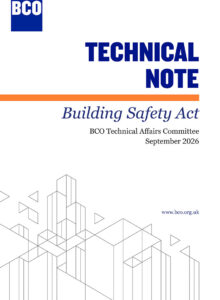
A new BCO Technical Note on the Building Safety Act – available exclusively to BCO members – examines the key changes introduced by the Act and subsequent amendments to the Building Regulations, and explains why they matter for office developers, owners, designers, contractors and building managers.
If you engage in a construction project in England, you will be directly affected by the changes this Act has made, with some provisions also extending to Wales.
Scotland and Northern Ireland rely on their own legal framework for building standards and safety regulations, but it is important to be aware that the devolved nations may choose to implement similar measures that align with the principles of the BSA.
If you are an office developer, owner, designer, contractor or building manager, the BCO encourages you to become more familiar with the requirements of the Act and how the changes may affect you.
Much of the industry’s attention has focused on higher-risk buildings (HRBs), the changes extend more widely and while, at first glance, this would suggest that this is aimed purely at residential buildings, this is not the case.
Many office buildings are part of mixed-use developments which are covered by the higher-risk regime and whether or not they fall into the category of an HRB they are affected by consequential changes to the Building Regulations.
Office developments that are classified as HRBs are subject to the full requirements of the BSA and must follow the prescriptive gateway approval processes. However, even offices that are not classified as HRBs are significantly impacted by the new safety regulations and statutory responsibilities for developers and contractors required by the changes to the regulations.
An office building may become classified as an HRB if it meets the height or storey threshold and contains more than two residential units, or if it is connected via a communal basement and/or podium to a qualifying building.
- The higher-risk building regime and how it can apply to office and mixed-use developments
- New dutyholder responsibilities and competence requirements
- Gateway 2 and 3 and changes to the building control process
- The “golden thread” and new information requirements
- The role of the Building Safety Regulator
- Requirements including mandatory occurrence reporting, notifiable changes and compliance declarations
- Bringing together the key concepts, terminology and responsibilities introduced by the new regime, this technical note aims to increase awareness of the changes and encourage further consideration of how they apply to office projects.



 By BCO Media