BCO London seminar and tour: Inside GSK’s smart HQ – buildings that help business and people thrive
What does it really take for a smart building to help people feel better, work better, and perform better?
 December 03, 2025


What does it really take for a smart building to help people feel better, work better, and perform better?
That question sat at the heart of the BCO London Committee’s recent seminar and tour of GSK’s award-winning London headquarters – a morning filled with bold ideas, frank discussions, and an honest look at what it means to deliver smart at scale.
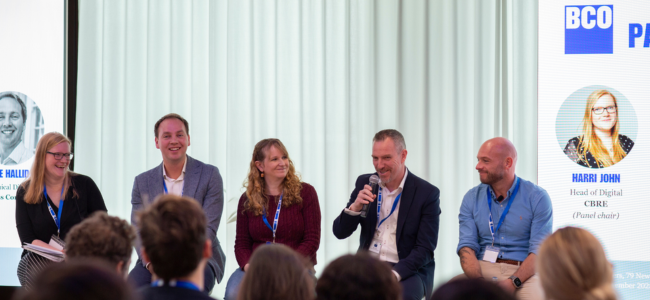
Chaired by Harri John, CBRE’s head of digital, the panel brought together leaders from GSK, Google, Cordless Consultants and Royal London to explore the evolving world of intelligent workplaces.
Where smart starts: Human behaviour and ethical data
Chris Higgins, head of property EMEA at GSK, opened the conversation with a story that immediately grounded the morning’s theme: the importance of trust when gathering personal wellbeing data.
GSK’s workplace science project collected information from volunteers on sleep, step counts and daily activity – deeply personal metrics. Higgins recalled the initial anxiety within GSK’s IT security team when the idea was first proposed back in 2017.
“We didn’t hide anything — we asked very openly.”
— Chris Higgins, GSK
Every data point, from Fitbit to Apple Watch, was anonymised through an independent system before it ever reached GSK. Participants opted in with full transparency and, crucially, the insights were shared back with them. According to Higgins, seeing tangible improvements created a positive feedback loop that encouraged healthier behaviours.
The project’s success wasn’t just technical; it was cultural. Talking openly about health, Higgins said, helps people become more mindful of it.
Scaling smart globally: What works in London doesn’t always work in Dublin
Shifting from a single building to global strategy, Kathy Farrington, digital buildings lead at Google, explained how Google’s smart building vision has evolved – and how difficult it is to replicate innovations across continents.
“We quickly discovered that what works in London doesn’t necessarily work in Dublin.”
— Kathy Farrington, Google
Google’s early focus was on transforming the construction phase: standardising processes, rethinking build sequences, even constructing comms rooms first so devices could be connected earlier.
But scaling smart globally meant reimagining the entire approach. The result?
More automation, more centralisation, and less reliance on contractors that vary by region.
One standout innovation was Google’s open-source device qualification tool, Test Run – a GitHub-based system that allows manufacturers to pre-test devices before bringing them to Google for approval. Adoption soared. Timelines shrank. Global alignment strengthened.
Farrington also described Google’s three-strand smart strategy – insights, manageability and cybersecurity – and how separating these has transformed internal collaboration.
Manageability, in particular, excites everyone:
“The idea that you could configure all devices with a single push of a button — instead of manually — is incredibly appealing.” – Mike Halliday, Technical Director at Cordless Consultants
Building for a future you can’t predict
When it comes to challenges, Mike Halliday, technical director at Cordless Consultants, didn’t sugar-coat the reality. “Smart,” he said, means everything and nothing at once.
Buildings being designed today won’t be occupied for years to comeand by then technologies will have shifted again.
Halliday’s advice on navigating that shift? Start with the fundamentals:
- A clear vision
- Open protocols
- A robust technology backbone
- Controlled, phased adoption
“A solid foundation, built early, is the key.”
— Mike Halliday, Cordless Consultants
Landlords, tenants and the battle for flexibility
From the landlord perspective, Mark Carroll, development management at Royal London, highlighted the delicate balance between designing for the unknown and meeting evolving occupier needs.
GSK is a prime example: when Royal London first began talks with the business, its vision was still forming. Both teams had to learn – and pivot – together.
And sometimes, Carroll admitted, smart features simply miss the mark:
“We once developed a feature where, when someone got off a train within 1.5 miles, the showers would sanitise and the coffee machines would start up. It sounded impressive… but no one used it.”
— Mark Carroll, Royal London
The message was clear: flexibility beats futurism. Over-engineering leads to waste.
What occupiers really want
From the tenant side, GSK and Google shared candid insights.
Higgins explained that sometimes the most important request is not to install technology the tenant won’t use – highlighting the friction between accreditation-led requirements and practical workplace needs.
Farrington added that Google now focuses on creating “smart-ready” buildings rather than fully smart ones at handover.
“Technology moves too quickly. A use case designed today will be outdated in ten years.”
— Kathy Farrington, Google
Fundamentals first. Use cases later.
Smart advice:
To close, CBRE’s John asked each panelist for one piece of advice:
Mike Halliday, Cordless
Focus on the digital foundation. Avoid vendor lock-in. Don’t chase shiny tech.
Kathy Farrington, Google
Start with strategy and gain top-down support. Smart is cultural, not just technical.
Mark Carroll, Royal London
Bring smart thinking in early – as early as architecture. And keep talking to tenants.
Chris Higgins, GSK
Be clear on your North Star. For GSK, it was “the world’s healthiest workplace.”
As the event concluded and delegates explored GSK’s smart-enabled spaces, one thing was clear: the future of smart buildings isn’t about technology alone.it’s about trust, collaboration, flexibility, and purpose.
The organisations leading the way aren’t those installing the most sensors, they’re the ones asking the right questions, building the right foundations, and aligning around a shared vision of what smarter really means.


 By BCO Media